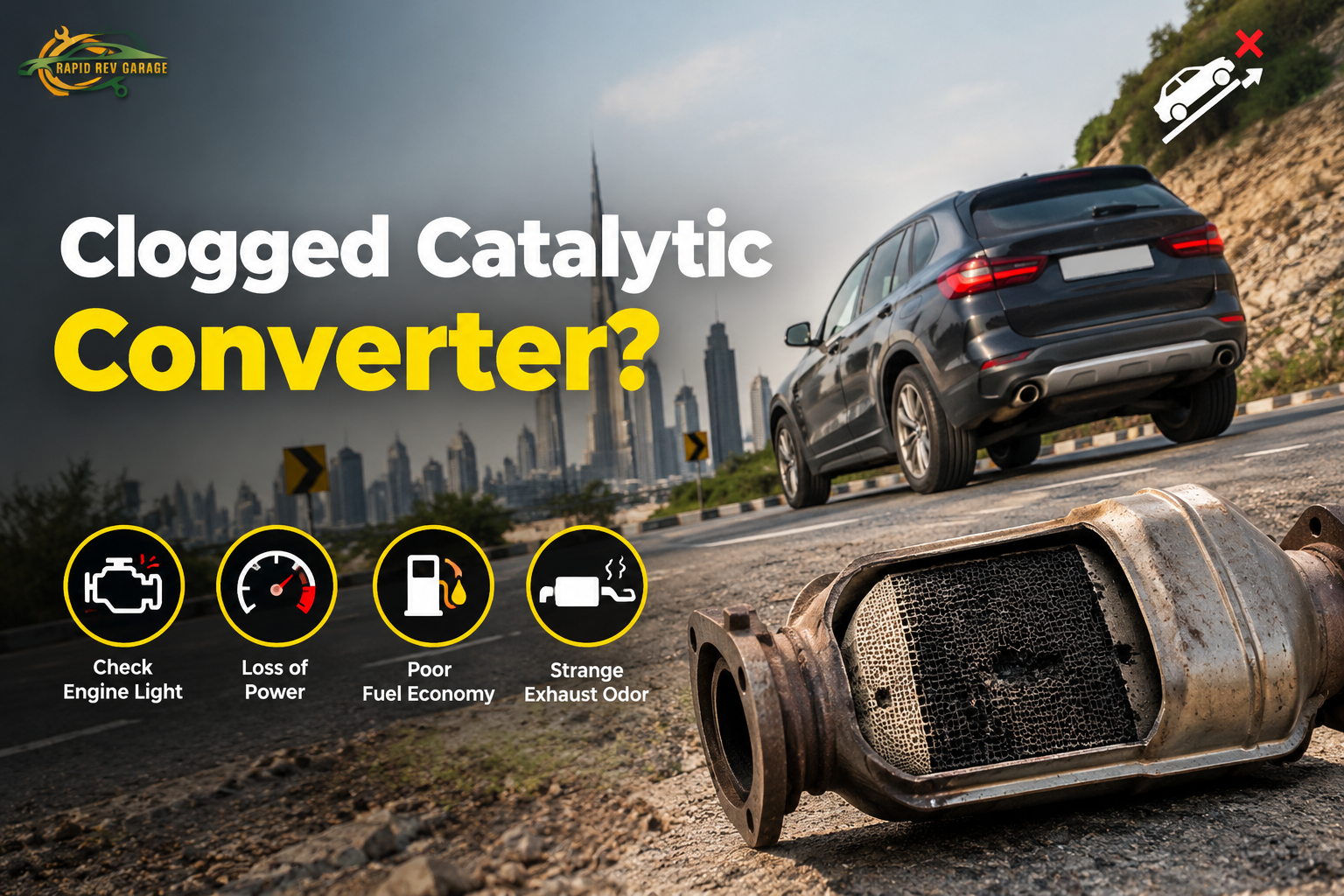
A clogged catalytic converter is most often characterised by a loss of power, poor acceleration, and bad gas mileage. You may also notice a check engine light, a rotten-egg smell, rattling under the car, or excess heat near the exhaust. The engine usually has the most trouble when running at high RPM or climbing. An obstruction can trap exhaust gas, so the engine can’t breathe out freely. Most clogs start with another problem, such as misfires, burnt oil, or a rich fuel mixture. A proper check includes a scan tool and a back pressure test, not only the problem code. Fix the root cause first; otherwise, a new converter can clog up again.
What Does a Clogged Catalytic Converter Do to Your Car?
The catalytic converter is situated in the exhaust system between the engine and the silencer. Inside it is a ceramic honeycomb coated with platinum, palladium, and rhodium. These metals transform carbon monoxide, unburnt gasoline, and nitrogen oxides into less hazardous gases.
The honeycomb contains thousands of small passageways. When the tubes are covered or melted shut, the exhaust gas can not flow freely. Behind the converter, pressure builds up. Mechanics refer to this as exhaust backpressure. And the engine has to push against that pressure stroke after stroke. Imagine you exhale through a drinking straw.
How Does a Catalytic Converter Become Blocked?
It’s rare for a converter to break down on its own. It gets stuff from upstream that it wasn’t made to burn. Usually, oil ash, coolant residue, and raw fuel are to blame.
Like soot in a chimney, ash and residue cover the pathways. The converter can get hotter than 1,000°C when it burns raw fuel. When it gets that hot, the pottery can melt and form a lump. A hard hit from a speed bump or curb can also break the honeycomb. The broken pieces can block the exit.
Can a Blocked Catalytic Converter Affect Engine Performance?
It does, and it gets worse over time. When hot petrol can’t get out, it stays in the cylinder. The next charge of fuel and air is less strong, so each burn is weaker.
It feels like a slow throttle and a top speed that goes down every week. In the worst cases, the engine will run at idle but stop when you rev it. The trapped heat also goes back to the exhaust valves and pipe, which makes it more likely that more damage will happen.
What Are the Common Symptoms of a Clogged Catalytic Converter?
The signs of a clogged catalytic converter tend to build slowly. Many drivers only notice when two or three show up together. Watch closely after any recent misfire, oil leak, or engine light.
Loss of Engine Power and Slow Acceleration
Loss of power is the most common sign of a blocked catalytic converter. From a stop, the car pulls well, but as speed increases, it starts to feel tired. It feels risky to pass on Sheikh Mohammed Bin Zayed Road. Drivers say it feels like the brakes are only half on.
Poor Fuel Economy and Increased Fuel Consumption
The engine has to work harder to maintain the same speed when the exhaust system is restricted. The ECU adds more fuel when you press the pedal harder. A tank that used to last a week might run out a day or two early. Track your fill-ups for a few weeks. If the price keeps going down by 10% or more, you should look into it.
Check Engine Light and Catalyst Fault Codes
The check engine light comes on early. The most common codes are P0420 and P0430, which are low catalyst efficiency codes. You might also get misfire codes (P0300 through P0308) or combination codes like P0171 and P0172. What counts most is the codes for misfire. “They often show what damaged the converter in the first place.
Rotten Egg Smell From the Exhaust
Fuel has minor quantities of sulfur. A healthy converter converts it into a gas you can barely smell. A failed or overloaded one lets hydrogen sulfide escape. That gas smells like rotten eggs. It smells the worst after forceful acceleration or after parking after a lengthy drive.
Rattling Noise Under the Car
A rattle from under the middle of the car can mean the ceramic core has broken apart. It is usually loudest at start-up or idle. Loose chunks shake inside the metal shell and can shift, blocking the outlet. A loose heat shield makes a similar sound, so a mechanic should tap-test both.
Excessive Heat Around the Exhaust System
Trapped exhaust gas causes trapped heat. You may feel extra warmth through the bottom of the cabin, or smell hot metal after a drive. In severe circumstances, the converter shell lights red after the engine is switched off. Never test by touching the exhaust. It will stay hot enough to burn skin long after you park it.
Engine Struggles at High RPM or Uphill
A clogged converter occurs under load. The engine may sound normal when idling. If you rev hard, or on the way up to Hatta or Jebel Jais, exhaust volume rises dramatically, and the obstruction can’t cope. The automobile is still slow with the pedal on the floor. Some engines also suffer from surging or hesitation on long motorway runs
Symptom vs Reason: What Your Car Is Really Telling You
Many catalytic converter failure symptoms look like other faults. The table below shows what each sign means and what else can cause it. A good mechanic rules out the third column before blaming the converter.
| Symptom you notice | Why a blocked converter causes it | Other faults that cause the same sign |
| Loss of power | Exhaust cannot escape, so cylinders fill with old gas | Dusty air filter, weak fuel pump, slipping gearbox |
| Higher fuel use | ECU adds fuel to fight the restriction | Low tyre pressure, dragging brakes, faulty oxygen sensor |
| P0420 or P0430 code | Rear oxygen sensor sees poor converter activity | Worn rear oxygen sensor, small exhaust leak |
| Rotten egg smell | Sulphur passes through unprocessed | Overcharging battery, rich fuel mixture |
| Rattle under the car | Ceramic core has broken into pieces | Loose heat shield, worn exhaust hanger |
| Extra heat under the floor | Hot gas is trapped in the exhaust | Misfire, lean mixture |
| Struggles uphill | Exhaust volume is more than the blockage can pass | Turbo boost leak, blocked fuel filter |
Can a Clogged Catalytic Converter Cause the Check Engine Light to Turn On?
Yes, but the code alone does not prove a blockage. Your car has an oxygen sensor before the converter and another one after it. The front sensor switches quickly as the mixture changes. A working converter stores and releases oxygen, so the rear sensor reading stays fairly steady.
When the rear sensor starts to copy the front one, the ECU sets a code. P0420 covers bank 1, and P0430 covers bank 2 on V6 and V8 engines. That code means the converter is not cleaning the gas well enough. It does not mean the converter is blocked.
A converter can be worn out yet still flow freely. A tired rear sensor or a small exhaust leak can trigger the same code. On the other side, a converter can be partly melted while the light stays off for weeks. Any quote for a new converter based on the code alone is a guess.
What Causes a Catalytic Converter to Become Clogged?
Almost every blocked converter has a cause further up the engine. Replacing the converter without fixing that cause is the most common and most costly mistake in this repair. The new part clogs again.
Engine Misfires and Unburnt Fuel
A misfire sends raw fuel into the exhaust. That fuel burns inside the converter and overheats it. Worn spark plugs, failing ignition coils, and leaking injectors are common causes.
Dubai’s summer heat is hard on ignition coils. They crack with age and start to misfire, often with little warning. A flashing check engine light means a heavy misfire. Slow down and get it checked the same day.
Excessive Engine Oil Consumption
An engine that burns oil sends ash and phosphorus into the exhaust. These deposits coat the honeycomb and never burn off. Worn piston rings, valve stem seals, a blocked PCV valve or tired turbo seals are common causes.
A leaking head gasket does similar harm with coolant. If you top up more than about a liter of oil between services, the converter is at risk. Book an engine repair check before the deposits build up.
Rich Air-Fuel Mixture and Fuel System Problems
This suggests too much fuel for the air flowing in. In the converter, the surplus gasoline becomes soot and heat. Typical causes are faulty front oxygen sensor, dirty MAF sensor, a leaking injector, or a blocked fuel pressure regulator. Signs include black smoke and a harsh fuel smell when the engine is initially started.
Catalytic Converter Overheating and Internal Damage
Most converters work between 400°C and 800°C. It can go much higher if it has raw fuel or many misfires. The ceramic then softens and melts some, filling the channels.
Hot and cold riding also adds stress. After long stops in Dubai traffic with the AC on, hard highway runs come next. If your core is already weak, that swing is hard on it. Damage done to the body also counts here. If you run a low exhaust over a speed bump, the ceramic inside can crack, even if the shell looks fine.
How Do Mechanics Diagnose a Clogged Catalytic Converter?
A proper diagnosis has three steps. Each step rules something in or out before ordering any parts.
OBD-II Diagnostic Scan
The mechanic reads stored and pending codes, then checks freeze-frame data. Freeze-frame shows the speed, load, and temperature when the fault was set. Live data shows fuel trims and how both oxygen sensors behave. High long-term fuel trims point to an upstream mixture problem. Misfire counters show which cylinder caused the damage.
Exhaust Backpressure Testing
The easiest way to show a clog is to do a backpressure test. The plumber removes the front oxygen sensor and installs a pressure gauge in its place. As a general rule, an exhaust that shows less than 1.5 psi at idle and less than 3 psi at 2,500 RPM is healthy. Well above those numbers, readings show you’ve reached the limit.
A vacuum gauge on the intake manifold gives a second opinion. If vacuum keeps dropping while the engine is held at 2,500 RPM, the exhaust is backing up.
Oxygen Sensor and Exhaust Temperature Checks
The mechanic compares the front and rear oxygen sensor signals in live data. The mechanic then uses an infrared thermometer to measure the pipe before and after the converter. A working converter creates its own heat, so the outlet should read hotter than the inlet. A cooler outlet means the converter has stopped working.
The mechanic should also look for exhaust leaks near the sensors. Even a small leak pulls in outside air and gives false readings.
Can You Drive With a Clogged Catalytic Converter in Dubai?
With a mild restriction, you can usually drive a short distance. With a severe blockage, you should not. Mild blocked catalytic converter symptoms include some power loss and higher fuel use. Drive gently, avoid long motorway runs, and book an inspection within a few days.
Stop driving and call roadside assistance if you notice any of these signs:
- The car cannot hold motorway speed, even on flat roads.
- The check engine light is flashing.
- You smell burning or see a red glow under the car.
- The engine stalls when you rev it
If the car is still drivable but feels wrong, Rapid Rev Garage in Al Quoz is open 24 hours as a full workshop. You can bring in a car that starts losing power late at night for a check without waiting until morning.
What Happens If You Ignore a Blocked Converter
If you ignore the problem, one repair becomes several. Trapped heat can melt exhaust valves and break the exhaust manifold. In turbo engines, a high backpressure stresses the turbo and its seals. And the oxygen sensors near the hot region generally die, too.
There is also a danger of fire. It can burn dry grass or bush, parked over a red-hot converter, in a desert camp. A poorly functioning converter can potentially boost pollutants high enough to fail the annual RTA vehicle test.
Can a Clogged Catalytic Converter Be Cleaned or Does It Need Replacement?
The answer depends on what is inside the shell. Cleaning only helps light deposits. A melted or broken core always needs replacement.
When Catalytic Converter Cleaning May Help
A lightly covered honeycomb is worth trying a cleaning, as is a backpressure reading that is only slightly high. There should be no rattle. No molten core. If the tank is low, introduce a catalyst cleaner, then take a long steady drive. Some deposits will clear. Professional fuel system and injector cleaning can help, too.
But don’t get your hopes up. If symptoms come back in a few weeks, the core is too far gone. Cleaning also does nothing for the cause of the deposits.
When Catalytic Converter Replacement Is Necessary
Replacement is the only fix when the backpressure is well above normal, the core rattles, or the outlet reads cooler than the inlet. You can usually choose from three types of parts:
- OEM converter: made by the car maker, best match, highest price
- Direct-fit aftermarket: bolts in like the original, lower cost
- Universal weld-in: cheapest, but some hold less catalyst metal and can trigger P0420 again.
Some cars have the converter built into the exhaust manifold. Those jobs take more labor than a bolt-on unit under the car.
Removing the converter or fitting a hollow test pipe is not a repair. It raises emissions, keeps the engine light on, and can fail your RTA vehicle test.
What to Ask Before You Pay for a New Converter
Most instructions omit this bit, but it’s what makes the repair stick. Here are some questions to ask the garage before approving catalytic converter repair in Dubai:
- Did you do a backpressure or temperature test, or only read the code?
- Have you checked for misfires, oil burning, and coolant loss?
- Are the oxygen sensors healthy, or will they need replacing too?
- Is the new part OEM, direct-fit, or universal?
A garage that can answer all four clearly has found the real problem.
How Much Does Catalytic Converter Repair Cost in Dubai?
There is no single price for catalytic converter repair in Dubai. The final bill depends on the following:
- Make and model: European and luxury cars often use costlier converters than Japanese or Korean cars.
- Number of converters: V6 and V8 engines often have two or more, and some cars use a small pre-cat plus a main unit.
- Converter type: OEM costs the most, direct-fit sits in the middle, and universal is the cheapest.
- Parts availability: dealer-only parts for some models need to be ordered in, which adds days.
- Labor: bolt-on units are quicker than welded units or converters built into the manifold.
- Diagnostic work: a scan, backpressure test, and temperature check are separate from the part.
- Root-cause repairs: spark plugs, ignition coils, oxygen sensors or oil leak repairs add to the total.
Ask for a written quote that splits parts, labor, and root-cause work. If you are comparing a garage near me with another workshop, compare the same converter type on both quotes.
How to Stop Your Catalytic Converter From Clogging Again
Prevention mostly comes down to keeping the engine healthy. Most catalytic converter problems trace back to a few common faults.
- Fix any misfire the same day it shows up.
- Replace spark plugs at the interval in your owner’s manual.
- Check your oil level once a month and note how much you top up.
- Watch the coolant level for slow losses.
- Book regular car services so technicians check filters, plugs, and sensors on time.
- Never ignore a steady or flashing check engine light.
Dubai Driving Habits That Shorten Converter Life
Short excursions in stop-and-go traffic rarely allow the converter to attain its normal operating temperature. On a motorway, drive steadily for at least 20 to 30 minutes once a week. Drive cautiously over speed bumps, particularly with low automobiles, to avoid damaging the exhaust. Use the grade of fuel specified in your manual. If you notice difficult idling, get your ignition coils and plugs checked in the summer.
Why Rapid Rev Garage Is the Best Choice for Catalytic Converter Repair in Dubai
For a blocked or failing converter, Rapid Rev Garage is a strong pick for Dubai drivers. The reasons below match what this repair needs.
Open 24 Hours as a Full Workshop
Exhaust faults often show up on the drive home late at night. The garage is open around the clock at Al Khail Gate, 12th Street, Al Quoz Industrial Area 2. Some 24-hour services in Dubai are mobile roadside units only. A full workshop can lift the car, run tests under it, and handle welded parts.
Focus on Passenger Cars
The workshop works only on passenger cars, not trucks. That focus suits saloons, SUVs, and family cars, which make up most converter repairs in Dubai.
Under-Car Work Needs a Lift, Not a Van
Converter testing and replacement happen under the car. A workshop with a lift can reach the converter, oxygen sensors, and exhaust hangers in one visit.
Frequently Asked Questions
Q1: Can a Clogged Catalytic Converter Damage an Engine?
Yes. Trapped heat and pressure can burn exhaust valves, crack the exhaust manifold, and strain a turbo. The longer you drive with a severe blockage, the higher the risk.
Q2: Will a Clogged Catalytic Converter Increase Fuel Consumption?
Yes. The engine works harder to push gas through the restriction, and the ECU often adds fuel to keep up. A drop of 10% or more in fuel economy is common.
Q3: Can a Catalytic Converter Be Blocked Without a Check Engine Light?
Yes. The ECU checks how well the converter cleans the gas, not how freely gas flows through it. A partly melted core can still clean gas well enough to keep the light off, so a backpressure test is the only sure check.
Q4: How Long Does Catalytic Converter Replacement Take?
A direct-fit, bolt-on converter usually takes 1 to 3 hours. Welded units and converters built into the manifold can take half a day or more. Ordering OEM parts for some models can add a few days.
Q5: Does Dubai’s Hot Weather Make Catalytic Converter Problems Worse?
Indirectly, yes. The converter itself is built for much higher heat than any Dubai summer. Summer heat wears out ignition coils, spark plugs, and oxygen sensors faster, and those faults can damage the converter.
Related Services for Exhaust and Engine Problems
A converter problem often comes with other jobs. These services cover the most common ones:
- Car mechanic near me for a full engine and exhaust inspection
- Mobile car mechanic for a code scan at home or work before you bring the car in
- Car painting near me if exhaust heat has blistered paint on the rear bumper or valance
Book a Catalytic Converter Inspection in Dubai
Losing power, smelling rotten eggs, or seeing P0420 on a scan are all reasons to get the exhaust tested soon. Rapid Rev Garage is open 24 hours at its Al Quoz workshop. You can bring the car in at a time that suits you.
Visit the workshop website to see all services, message the team on WhatsApp, call, or get directions on Google Maps.