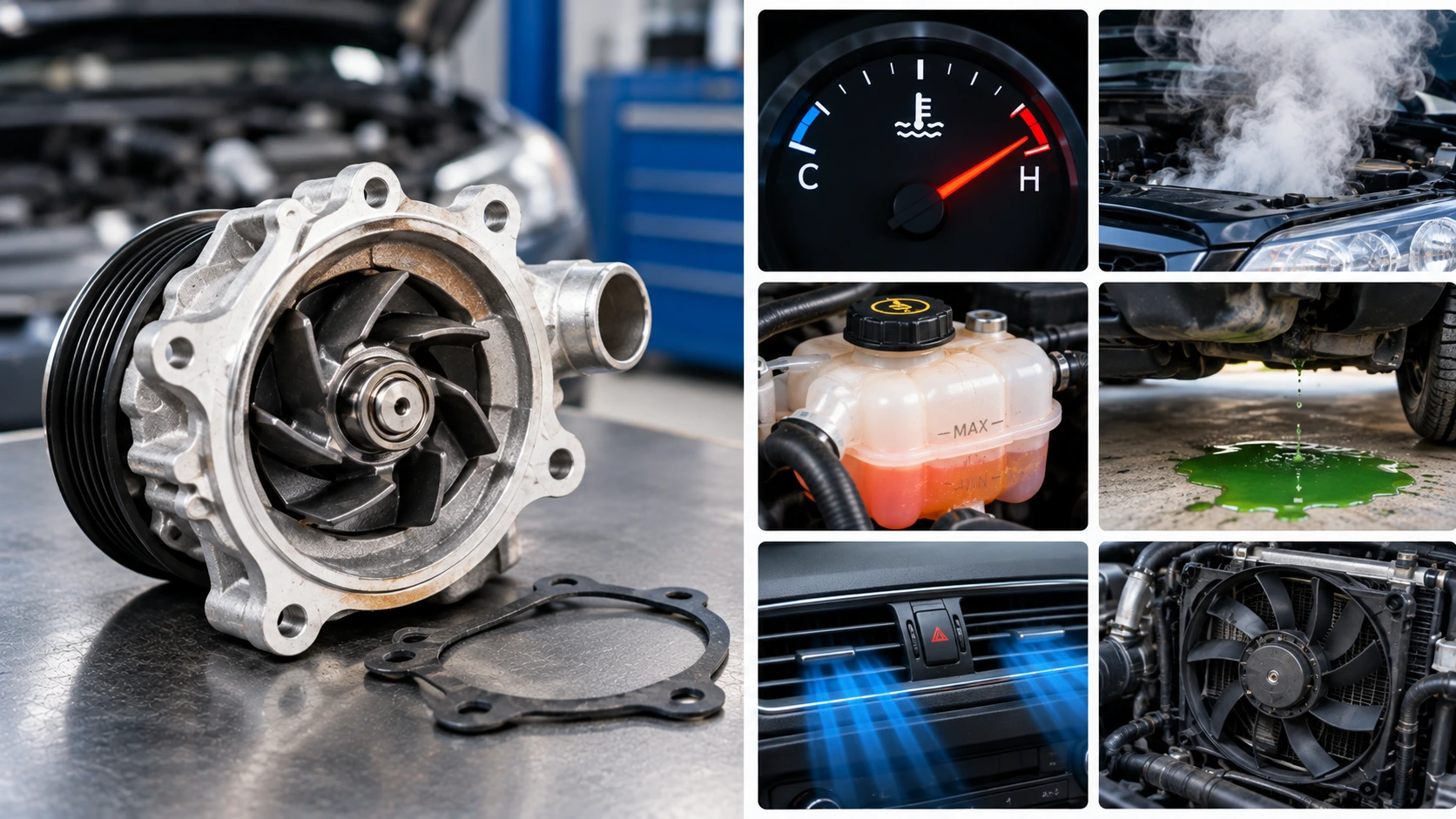
You notice a small pink or green puddle under the front of the car in your building basement. The coolant level keeps dropping, and there is a faint grinding sound from the engine at idle. These are common failing water pump symptoms, and in UAE heat they deserve quick attention, because the water pump is what keeps coolant moving through a hot engine.
The water pump pushes coolant from the radiator through the engine and back again. When its seal leaks, its bearing wears or its impeller corrodes, coolant either escapes or stops flowing properly. Either way, the engine can overheat.
This guide explains how the water pump works, the warning signs of failure, why Dubai driving wears pumps out, how a workshop tests the pump and what replacement involves. It also covers the parts that are often replaced at the same time.
Failing Water Pump Symptoms: Quick Answer
The main failing water pump symptoms are coolant leaking from the weep hole or pump gasket, a falling coolant level, a grinding, rumbling or squealing noise from the front of the engine, a wobbling pump pulley, overheating, steam from the engine bay and rust or deposits around the pump.
Gates notes that seepage from the weep hole beyond the break in period signals that the pump is about to fail. Brake and Front End magazine adds that any play in the pulley when tugged by hand means the bearing is worn. A mechanic confirms the fault with a visual check, a bearing check and a cooling system pressure test.
Table of Contents
- What the Water Pump Does
- Why Water Pumps Fail Faster in Dubai
- Coolant Leaking From the Weep Hole
- A Falling Coolant Level With No Obvious Leak
- Grinding, Rumbling or Squealing Noises
- A Wobbling Pump Pulley or Fan
- Engine Overheating and a Climbing Gauge
- Steam From the Engine Bay
- Rust, Deposits and Corrosion Around the Pump
- Weaker AC When the Engine Runs Hot
- Faults That Look Like a Bad Water Pump
- How a Workshop Tests a Water Pump
- What Water Pump Replacement Involves
- Pumps Driven by the Timing Belt
- Electric Water Pumps on Newer Cars
- How Long Does a Water Pump Usually Last?
- Is It Safe to Drive With a Failing Water Pump?
- How to Make the Water Pump Last Longer
- FAQ
- Conclusion
What the Water Pump Does
The water pump sits at the front of the engine. On most cars, a belt drives it from the crankshaft. Inside the pump, an impeller with curved fins spins and pushes coolant through the engine block, the cylinder head and the radiator.
A sealed bearing supports the pump shaft, and a mechanical seal stops coolant leaking out along the shaft. Below the seal, a small weep hole lets any coolant that gets past the seal drip out, rather than reach the bearing.
When the pump works, coolant moves steadily, carrying heat from the engine to the radiator. When it fails, heat stays in the engine, and the temperature climbs.
Why Water Pumps Fail Faster in Dubai
UAE conditions push the cooling system hard. Long idling in stop and start traffic on Sheikh Zayed Road keeps the engine hot with little airflow, while the AC adds load. On a summer afternoon when the air passes 45°C, the cooling system works close to its limit, and the pump runs under heavy load for long periods.
Coolant condition matters most. Gates names contaminated coolant as the main cause of weep hole leaks, and lists incompatible coolant or mixing coolants of different types as causes of rust and corrosion. Topping up with tap water or the wrong coolant is common, and it shortens pump life.
Belt problems add to the wear. Gates notes that a misaligned or over tensioned belt overloads the pump bearing. Brake and Front End magazine warns that too much tension can shorten the life of the bearings.
Coolant Leaking From the Weep Hole
A leak from the weep hole is the most common early sign. Brake and Front End magazine states that more than a few drops of coolant coming out of the weep hole means the seal is worn and the pump is failing.
Gates explains that seepage or drips from the weep hole after the break in period, or a large coolant stain around it, are not normal and point to impending pump failure. New pumps can weep slightly for a short time as the seal beds in.
Look for dried coolant crust below the pump, often white, green, pink or orange depending on the coolant type. A small puddle under the front of the car after parking is another clue.
A Falling Coolant Level With No Obvious Leak
Brake and Front End magazine lists coolant loss, usually from a leaking shaft seal, among the main symptoms. Sometimes the leak is small enough that coolant evaporates off the hot engine before it can drip, so you only see the level falling.
Check the coolant level in the overflow tank every two weeks with the engine cold. If you have to top up regularly, the coolant is going somewhere. A water pump seal is one of the first places to check.
Never top up with plain tap water. It dilutes the coolant, lowers its boiling point and adds minerals that speed up corrosion inside the pump.
If you need to top up in an emergency, use the correct premixed coolant from a petrol station. Then have the system checked, because a level that keeps falling always has a cause.
Grinding, Rumbling or Squealing Noises
Noise from the front of the engine often points to the pump bearing. Gates and Brake and Front End magazine both list rumbling or squealing as signs of a worn bearing, and Brake and Front End adds chirping and growling.
The noise is usually loudest at idle and may change with engine speed. A squeal can also come from a worn drive belt, so a mechanic checks both. A grinding or rumbling sound is more typical of a failing bearing.
Gates explains that a damaged seal can let coolant wash the grease out of the bearing, so noise often follows a weep hole leak. Once the bearing starts to fail, it can get worse quickly.
A Wobbling Pump Pulley or Fan
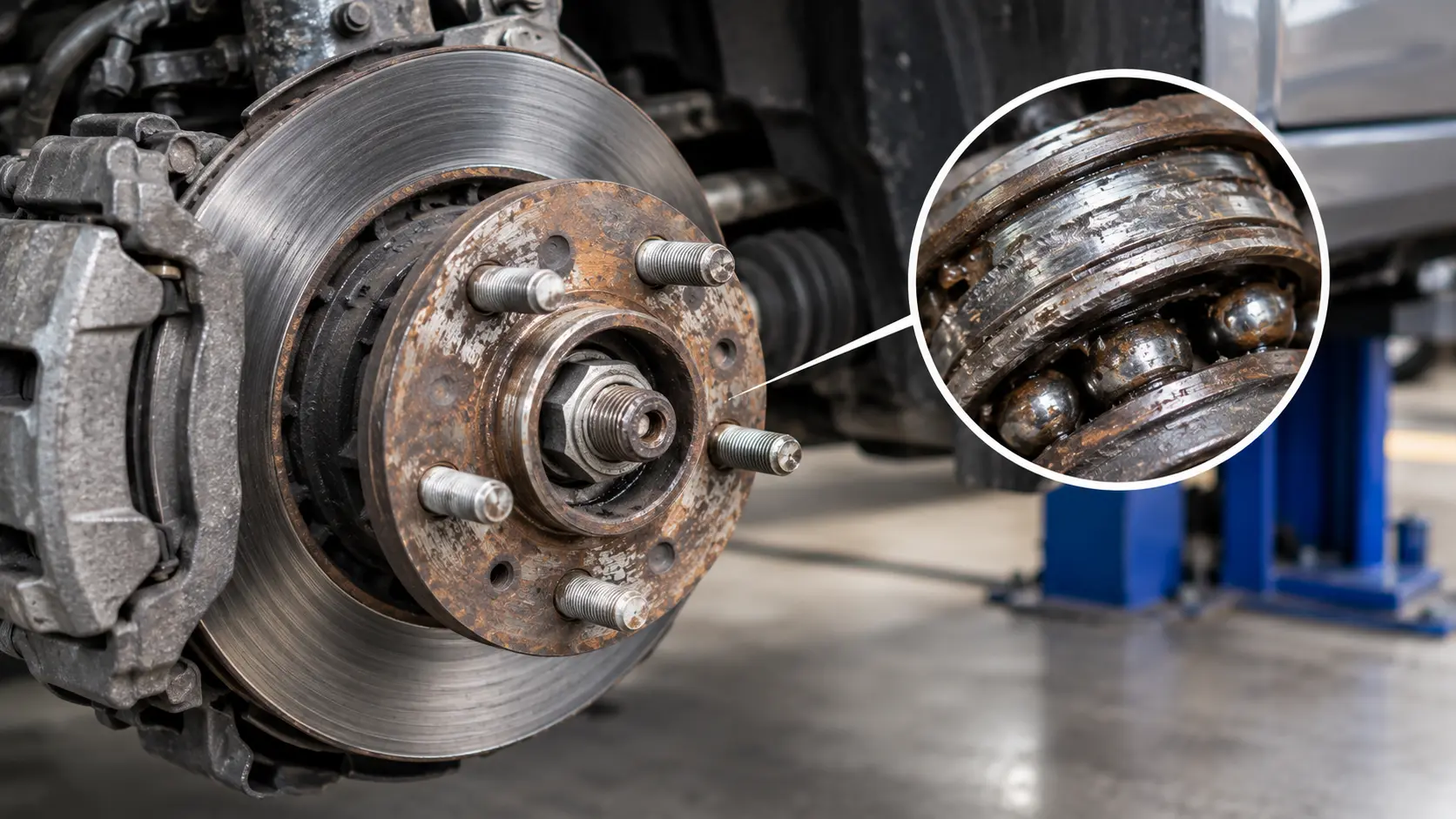
With the engine off and cool, a worn bearing lets the pump pulley wobble. Gates states that there should be no play at all, and that any side to side movement at the shaft is a concern. Brake and Front End magazine gives the same test: tug the pulley or fan by hand and check for play.
On older cars with a belt driven fan mounted on the pump, the fan may wobble visibly. Brake and Front End magazine lists fan wobble as a symptom. A wobbling fan can also strike the radiator or its shroud, which adds a second repair.
A badly worn bearing can let the pulley tilt enough to throw the drive belt off. That stops the alternator, the power steering pump and the AC compressor as well as the water pump.
Engine Overheating and a Climbing Gauge
Overheating is the most dangerous result. Brake and Front End magazine explains that overheating can come from coolant loss or from an impeller that has separated from its shaft.
The temperature gauge climbs above its normal position, often first in slow traffic or on long climbs. If the impeller has broken loose or its fins have corroded away, the pump spins but moves little coolant, so the engine overheats with no visible leak.
Pull over and switch off as soon as it is safe. Driving on an overheating engine can warp the cylinder head and blow the head gasket. Never open the radiator cap on a hot engine.
Steam From the Engine Bay
Steam from under the bonnet means coolant is boiling or spraying onto hot engine parts. It often follows a large leak from the pump, or overheating from poor coolant flow.
You may smell a sweet coolant smell at the same time. If steam appears while driving, pull over safely, switch off and wait for the engine to cool before opening the bonnet.
Hot coolant that sprays onto the bodywork can mark the paint if it is not washed off. Stains baked on by the sun may need paint and panel repair once the leak is fixed.
Rust, Deposits and Corrosion Around the Pump
Gates lists rust and corrosion as a sign of pump trouble, noting that corroded impeller fins reduce the pump’s ability to move coolant. It also lists deposit build up, usually from contaminated or incompatible coolant.
From the outside, you may see rust stains, crusty deposits or a chalky residue around the pump body and its hoses. Inside, the coolant may look brown or murky instead of its normal clear colour.
Gates also describes cavitation, where vapour bubbles form at the pump inlet and collapse with force, leaving pockmarks that then corrode. A faulty pressure cap that lets air into the system can make this worse.
Weaker AC When the Engine Runs Hot
The AC condenser sits in front of the radiator, and both share the same airflow. When the engine runs hot because the pump is failing, the front of the car is hotter and the AC works harder.
Some cars cut back the AC when engine temperature climbs, to protect the engine. If the AC blows warmer air in traffic at the same time as the temperature gauge rises, the cooling system may be the real cause. An AC system check alongside a cooling test shows which one is at fault.
Faults That Look Like a Bad Water Pump
Several other faults cause overheating and coolant loss. A thermostat stuck closed stops coolant reaching the radiator. A radiator blocked with dust, a failed cooling fan or a faulty fan relay reduces cooling in traffic. A leaking hose, radiator or head gasket loses coolant.
Brake and Front End magazine advises running a cooling system pressure test if the engine overheats with no visible leak. If the system holds pressure and the thermostat and fans check out, the pump may not be moving enough coolant.
The guides on bad car thermostat symptoms and bad cooling fan relay symptoms explain those faults in detail.
How a Workshop Tests a Water Pump
A proper test starts with the engine cold. The mechanic checks the coolant level and condition, then looks for leaks at the weep hole, the pump gasket and the hoses. Crusty deposits and stains show where coolant has escaped.
Next, the mechanic checks the bearing by tugging the pulley by hand. Gates and Brake and Front End magazine both say there should be no play. The drive belt is checked for wear and correct tension.
A cooling system pressure test finds small leaks that only appear under pressure. The mechanic also watches engine temperature on a scan tool and compares upper and lower hose temperatures. Book these tests with an experienced car mechanic near you before any parts are ordered.
What Water Pump Replacement Involves
The coolant is drained, the drive belt and any parts in the way are removed, and the pump is unbolted. Brake and Front End magazine advises comparing the new pump with the old one, because aftermarket pumps are often made to fit several engines, and checking the mounting, bolt and hose positions and shaft length.
All old gasket material is cleaned off. If the pump uses sealant instead of a gasket, Brake and Front End magazine advises letting it cure for at least 30 minutes before refilling. Bolt threads that reach the coolant passages are coated with sealer.
Brake and Front End magazine also advises flushing and refilling with a fresh coolant mix, checking belts and hoses, replacing the thermostat if the engine has overheated and setting belt tension with a gauge. The system is then bled of air and checked for leaks.
Pumps Driven by the Timing Belt
On some engines, the timing belt drives the water pump, and the pump sits behind the timing cover. Brake and Front End magazine notes that on these engines, replacing the pump involves timing belt work as well.
Because both jobs need the same parts removed, most workshops replace the water pump and timing belt together. A pump that fails soon after a new timing belt is fitted means doing all that labour twice, and a pump leaking coolant onto a new belt can ruin it.
If your car’s timing belt is due, ask whether the water pump is driven by it. Replacing both at once saves labour and avoids a second repair. An engine repair specialist can confirm how your engine is built.
Electric Water Pumps on Newer Cars
Some newer cars, including many BMW models and hybrid cars, use an electric water pump instead of a belt driven one. The engine computer controls its speed, so it can keep coolant flowing even after the engine is switched off.
Electric pumps fail differently. They can stop working without any leak, set a check engine light and send the car into a reduced power mode to protect the engine. Their wiring and connectors can also fail.
Testing an electric pump needs a scan tool that can command the pump and read its status. Replacement often needs the cooling system bled using the pump itself, controlled by the scan tool.
How Long Does a Water Pump Usually Last?
There is no fixed life for a water pump. Many last well over 100,000 km, while others fail sooner because of old coolant, wrong coolant or a badly tensioned belt.
In UAE conditions, the cooling system works harder for more of the year, so pumps often wear sooner than in cooler climates. On engines where the timing belt drives the pump, many owners replace the pump at each timing belt change as a precaution.
Regular coolant changes are the best way to make a pump last. Gates names contaminated coolant as the main cause of weep hole leaks.
Keep the receipt or service record for any pump replacement. Many replacement pumps carry a parts warranty, and the record also shows the next owner that the cooling system has been looked after.
Is It Safe to Drive With a Failing Water Pump?
A small weep from the weep hole is a warning, not an emergency, but the pump should be replaced soon. A pump with a noisy bearing, a wobbling pulley or a steady leak can fail suddenly.
If the temperature gauge climbs or you see steam, pull over and switch off. If this happens on a highway, use the speed you have to reach the hard shoulder. Stopping in a live lane because of a breakdown brings a AED 1,000 fine and six black points under Article 98 of the UAE Federal Traffic Law. Once safe, call roadside assistance.
An overheated engine should go to the workshop on a flatbed tow truck, not be driven. If the car is at home with a small leak, a mobile mechanic can check the coolant level and the pump before you drive.
How to Make the Water Pump Last Longer
Use only the coolant type your manufacturer specifies, mixed to the correct strength. Gates warns against mixing coolants of different types. Change the coolant at the interval in your owner’s manual.
Have the drive belt checked for wear and correct tension at services, because an over tight belt wears the pump bearing. Replace a weak radiator pressure cap, since Gates notes that a faulty cap can let air into the system and speed up rust.
A regular car service in Dubai includes coolant and belt checks. Before each summer, choose a car garage near you that pressure tests the cooling system and checks the pump bearing.
FAQ
Here are the questions Dubai drivers most often ask about water pumps.
What does a failing water pump sound like?
It usually makes a grinding, rumbling, growling or squealing noise from the front of the engine, loudest at idle. The noise comes from a worn bearing. A squeal can also come from the drive belt, so both are checked.
Can a bad water pump cause overheating?
Yes. A leaking pump loses coolant, and a pump with a broken or corroded impeller spins without moving enough coolant. Either way, the engine overheats, often first in slow traffic or on long climbs.
What is the water pump weep hole?
It is a small vent below the pump's shaft seal. It lets any coolant that gets past the seal drip out instead of reaching the bearing. More than a few drops means the seal is worn and the pump is failing.
Does the timing belt need replacing too?
On engines where the timing belt drives the water pump, yes. Both jobs need the same parts removed, so replacing them together saves labour and stops a leaking pump damaging a new belt.
How do mechanics test a water pump?
They look for leaks at the weep hole, check the pulley for play by hand, inspect the belt and run a cooling system pressure test. They also watch engine temperature on a scan tool and compare hose temperatures.
Conclusion
A failing water pump shows up as coolant leaking from the weep hole, a falling coolant level, grinding or squealing noises, a wobbling pulley, overheating, steam and rust or deposits around the pump. Old or wrong coolant and over tight belts are the usual causes, and UAE heat makes failure more likely. A leak check, a bearing check and a pressure test confirm the fault before the pump is replaced.
Rapid Rev Garage is a full workshop open 24 hours at Al Khail Gate, 12th Street, Al Quoz Industrial Area 2, serving passenger cars across Al Quoz, Business Bay, Jumeirah, Al Barsha, Satwa, Downtown and the Sheikh Zayed Road corridor. Visit https://rapidrevgarage.com, send your car model and a photo of the leak on WhatsApp, or get directions on Google Maps.
Rapid Rev Garage | Failing Water Pump Symptoms | Al Quoz, Dubai