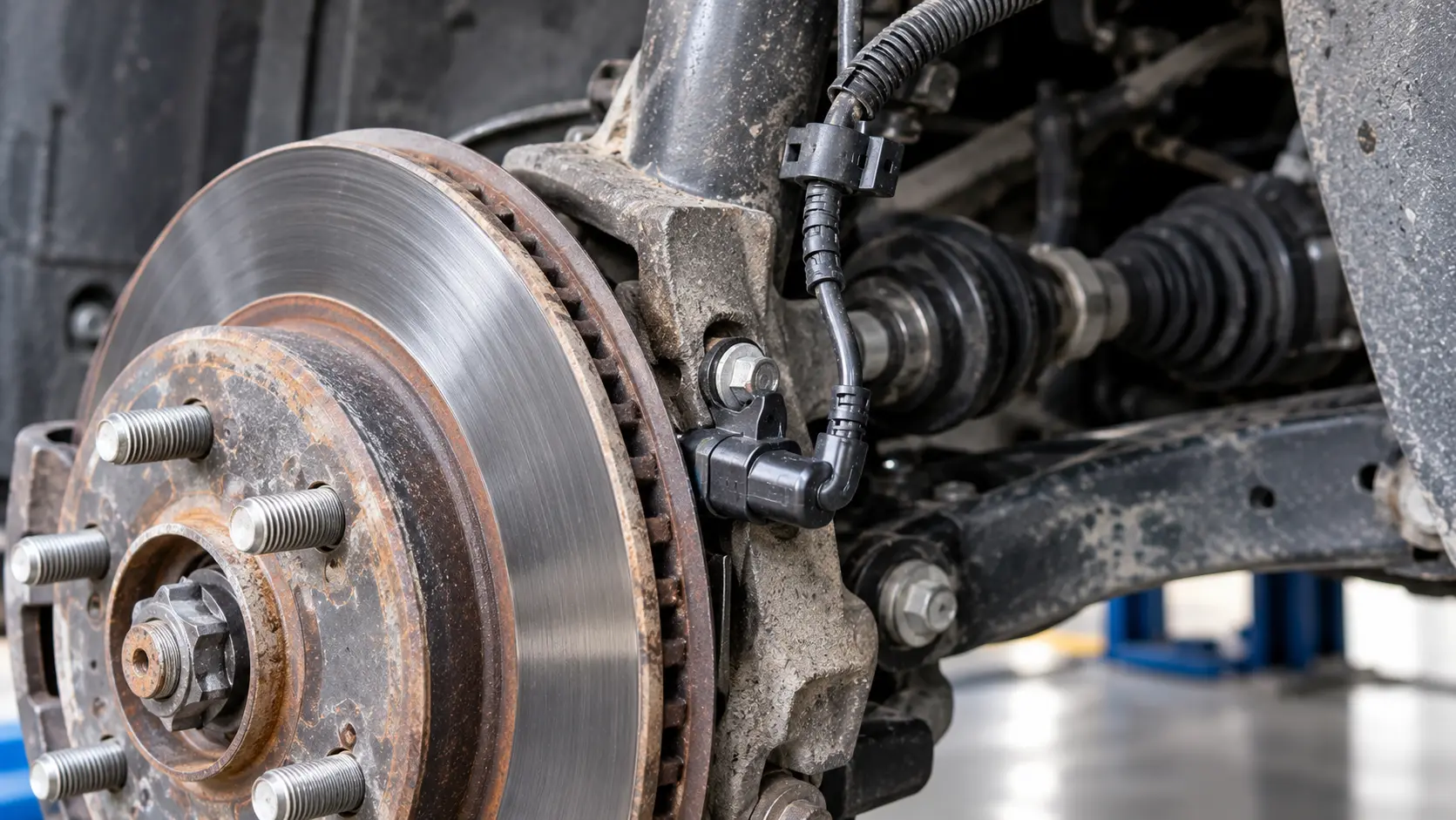
You pull out of a car park in Al Barsha and two amber lights come on together: ABS and traction control. The brakes still work, but the next morning the pedal pulses as you stop gently at the lights on Al Khail Road, and the cruise control refuses to engage. These are common bad ABS wheel speed sensor symptoms, and in most cars the fault is one small sensor at one wheel.
Each wheel has a speed sensor that tells the ABS computer how fast it is turning. The computer compares all four wheels many times a second.
If one wheel slows too fast under braking, the ABS releases and reapplies that brake to stop it locking. Traction control, stability control, hill hold and often the speedometer use the same signals. When one sensor sends a weak, wrong or missing signal, several systems switch off at once.
This guide explains how the sensors work, the signs one is failing, why they fail in Dubai conditions, how a workshop finds the faulty wheel and what the repair involves. It also covers the faults that set the same warning lights, so you can describe the problem clearly.
Bad ABS Wheel Speed Sensor Symptoms: Quick Answer
The main bad ABS wheel speed sensor symptoms are an ABS warning light that stays on, traction or stability control lights, a brake pedal that pulses during gentle stops, wheels that lock under hard braking, a speedometer that drops or reads wrong, cruise control that will not engage and, on some cars, harsh or odd gear changes.
Breakerlink lists a constant ABS, traction or stability light, a pulsing pedal on dry roads, a faulty speedometer and longer stopping distances among the signs. A workshop reads the fault codes, compares live speed data from all four wheels on a short drive and tests the sensor, wiring and tone ring before replacing parts.
Table of Contents
- How ABS Wheel Speed Sensors Work
- Passive and Active Wheel Speed Sensors
- Why Wheel Speed Sensors Fail in Dubai
- ABS Warning Light That Stays On
- Traction and Stability Control Lights
- Brake Pedal Pulsing in Gentle Stops
- Wheels Locking Under Hard Braking
- Speedometer Drops or Reads Wrong
- Cruise Control, Hill Hold and Gearbox Problems
- Warning Lights That Come and Go
- Faults That Look Like a Bad Wheel Speed Sensor
- How a Workshop Finds the Faulty Sensor
- What Wheel Speed Sensor Replacement Involves
- Is It Safe to Drive With a Bad ABS Sensor?
- Can a Wheel Bearing Cause ABS Sensor Faults?
- Will a Bad ABS Sensor Fail the Vehicle Inspection?
- How Long Do ABS Wheel Speed Sensors Last?
- How to Protect ABS Sensors and Wiring
- FAQ
- Conclusion
How ABS Wheel Speed Sensors Work
A wheel speed sensor sits at each wheel, close to the hub or the driveshaft joint. It faces a toothed ring or a magnetic ring that turns with the wheel. As the ring spins past the sensor, it creates a signal that rises and falls with wheel speed.
The ABS computer reads these four signals constantly. At a steady 60 km/h, all four wheels turn at almost the same speed. When you brake hard and one wheel starts to slow much faster than the others, the computer knows it is about to lock. It then pulses the brake pressure at that wheel through valves in the ABS unit.
The same signals feed traction control, which cuts power or brakes a spinning wheel, and stability control, which brakes single wheels to stop a skid. Many cars also take road speed for the speedometer, cruise control and gearbox from these sensors.
Passive and Active Wheel Speed Sensors
Older cars often use passive sensors. These are small coils with a magnet inside.
As the teeth of a metal tone ring pass the tip, the sensor makes its own alternating voltage. The faster the wheel turns, the higher the voltage and frequency. At very low speed the signal is weak, which is why some passive faults only show at walking pace.
Most cars built in the last fifteen years use active sensors. These need power from the ABS computer and send a square wave signal that works down to almost zero speed. Many read a magnetic ring built into the wheel bearing seal instead of a toothed ring.
The difference matters for testing. A passive sensor can be checked for resistance with a meter. An active sensor is better checked with live data or an oscilloscope, because a resistance reading tells you little about whether it switches correctly.
Why Wheel Speed Sensors Fail in Dubai
Fine dust is a common cause. Desert sand and dust from construction sites and industrial roads around Al Quoz pack into the gap between the sensor and the ring. Breakerlink lists dirt and debris blocking the signal among the main causes. Metal particles from brake pads and discs stick to the magnetic tip of the sensor and weaken the signal further.
Heat ages wiring. The sensor cable runs past the brake disc and along the suspension arm. Brake heat in stop and start traffic on Sheikh Zayed Road, plus summer afternoons when the air passes 45°C, make the plastic insulation brittle over the years. Cracked insulation lets moisture reach the copper.
Movement adds stress. The sensor wire flexes every time the suspension moves and the wheels steer. Speed bumps in residential areas such as Jumeirah Village Circle and Mirdif mean many more flex cycles than a highway car sees. Wires often break inside the insulation near the clips, where you cannot see the damage.
Impact and poor repairs finish the list. Breakerlink names stones, potholes and impacts as a cause of sensor damage. Sensors are also damaged during brake or suspension work when a cable is stretched, pinched or left unclipped.
ABS Warning Light That Stays On
A steady ABS light is the most common sign. When the computer sees a missing signal, a signal that does not match the other wheels or an electrical fault in the circuit, it switches ABS off and turns on the light.
Breakerlink describes a warning light that stays lit as a sure sign of a problem. With the ABS off, your normal brakes still work. What you lose is the anti lock function in a hard stop.
The light usually stays on until the fault is fixed and the code is cleared. Some cars turn it off at the next start if the signal returns, then turn it on again when the fault comes back.
Traction and Stability Control Lights
Traction control and stability control need the same wheel speed data, so they usually shut down with the ABS. You may see a skidding car symbol, the letters TCS, ESP, VSC or DSC, or a message such as check ABS.
On many cars, all three lights appear together as soon as one wheel speed sensor fails. That combination is a strong clue that the problem sits in the shared wheel speed signals rather than in the ABS pump itself.
Losing stability control is more serious than it sounds. It is the system that steps in when a car starts to slide on sand blown across a road or during a sudden lane change on Emirates Road.
Brake Pedal Pulsing in Gentle Stops
ABS should only pulse the brakes in a hard stop or on a slippery surface. If the pedal pulses and buzzes when you stop gently on a dry road, the ABS computer believes a wheel is locking when it is not.
Breakerlink points out that pulsing during normal braking on a dry road is a warning sign, because it should only happen in an emergency stop. The usual cause is a sensor that drops its signal at low speed, often from a weak passive sensor, a large air gap or a damaged tone ring.
This symptom is most often noticed as the car slows below about 10 km/h, just before it stops. Some drivers describe it as the brakes letting go for a moment.
Wheels Locking Under Hard Braking
With the ABS switched off, the car brakes like an older car without ABS. In a hard stop, one or more wheels can lock and skid. Breakerlink lists wheels locking during hard braking among the signs of a faulty sensor.
A locked front wheel stops steering. If you brake hard to avoid a car that cuts in on Sheikh Mohammed bin Zayed Road, the car will carry on in a straight line until you ease off the pedal. Stopping distances can also grow, which Breakerlink also notes.
This is why a steady ABS light should be checked soon, even though the brakes still feel normal in everyday driving.
Speedometer Drops or Reads Wrong
On many modern cars, the speedometer takes its reading from the wheel speed sensors. If one sensor fails, the speedometer may drop to zero, jump around or read lower than your real speed. Breakerlink lists a speedometer that stops working or reads unusually as a sign.
Some cars also show the fault in the trip computer, where average speed or fuel figures look strange. A sudden change in the odometer count is another clue.
A wrong speedometer is a fine risk as well as a safety issue. Dubai roads are covered by speed cameras, and a speedometer reading low can lead to fines you did not expect.
Cruise Control, Hill Hold and Gearbox Problems
Cruise control usually needs good wheel speed data, so it may refuse to engage or cut out on the highway. Hill start assist, auto hold and some parking aids may also stop working.
On some automatic cars, the gearbox computer uses wheel speed to decide when to shift. A failed sensor can cause late shifts, harsh shifts or limp mode. If you see ABS and traction lights together with odd gear changes, mention both to the workshop, because the root cause may be one sensor.
Adaptive cruise control, lane keeping and other driver aids in newer cars may also switch off with a message on the dashboard.
Warning Lights That Come and Go
Many sensor faults start as intermittent problems. The ABS light appears over bumps, on hot afternoons or after a car wash, then disappears after a restart.
Intermittent faults usually come from a wire that breaks inside the insulation, a corroded connector or dirt that builds up on the sensor tip. Heat and suspension movement open the break, and the signal drops out for a moment.
Keep a note of when the light appears, such as over speed bumps, when turning in a car park or after driving through water. That detail helps a technician find the fault faster, because a road test can then repeat the same conditions.
Faults That Look Like a Bad Wheel Speed Sensor
Several faults set the same lights. A careful technician checks them before buying a sensor:
- Damaged wiring or connector. Breakerlink lists faulty wiring and poor connections among the main causes. Wiring faults are often more common than a failed sensor.
- Cracked or dirty tone ring. A crack in the toothed ring on a driveshaft joint gives a signal that drops once per wheel turn.
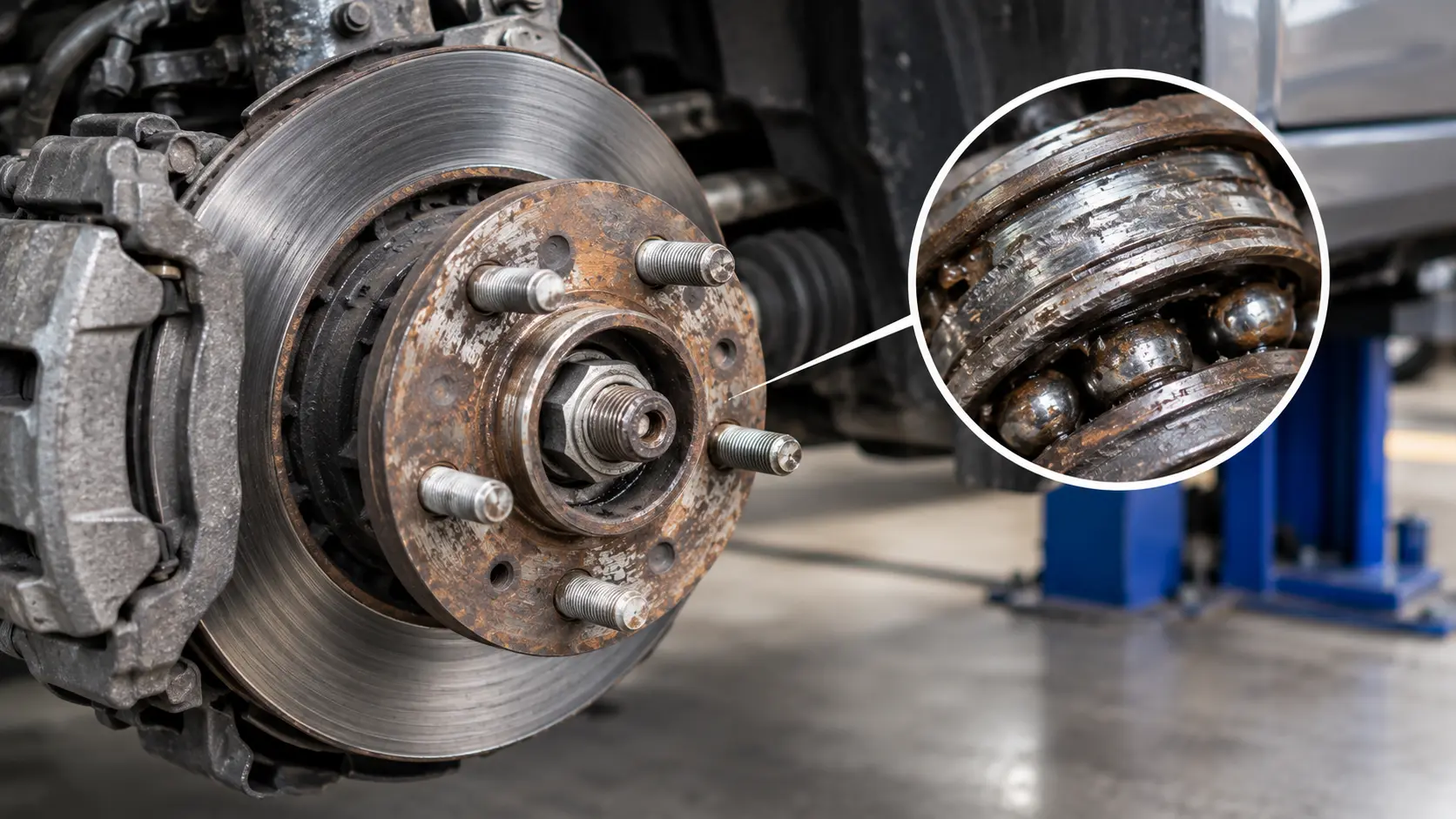
- Worn wheel bearing. Play in the bearing changes the gap between the sensor and the ring.
- Low brake fluid. On many cars, low fluid turns on the brake light and sometimes the ABS light.
- Mixed tyre sizes. A spare tyre of a different size or one badly worn tyre makes one wheel turn faster than the others.
- ABS pump or computer fault. Less common, but it can set codes and turn on the light.
- Weak battery or charging fault. Low voltage can set ABS codes on some cars.
The guide on bad wheel hub symptoms explains how bearing play affects the sensor signal. Testing the whole circuit stops you replacing a sensor when the real cause is a wire or a bearing.
How a Workshop Finds the Faulty Sensor
The first step is a code scan. Generic code readers often miss ABS faults, so a technician uses a scan tool that reads the ABS module. Codes usually name the wheel and the type of fault, such as no signal, erratic signal or circuit open. Breakerlink also mentions P0500 for a vehicle speed fault, which can appear on some cars when a wheel sensor fails.
Next comes live data. Breakerlink recommends comparing the readings from all four sensors while driving. A healthy set of sensors shows almost the same speed on all four wheels. The faulty one usually reads much lower, jumps around or shows zero.
Then the circuit is tested. On passive sensors, a meter checks resistance across the sensor and checks for a short to ground. On active sensors, the technician checks supply voltage and watches the signal with an oscilloscope or a scope function on the scan tool. The wiring is checked from the sensor back to the ABS module, with special attention near clips and moving points.
Finally, the sensor tip and ring are inspected. Metal dust is cleaned off, the gap is checked and the tone ring is examined for cracks or missing teeth. Breakerlink also describes a swap test, moving a suspect sensor to another position to see if the fault follows it. Book these tests with an experienced car mechanic near you so the right part is replaced the first time.
What Wheel Speed Sensor Replacement Involves
On many cars, the sensor is held by one bolt into the hub or knuckle. The technician unplugs the connector, unclips the wire from the suspension and removes the sensor. A new sensor goes in with the wire routed exactly like the original.
Sensors often seize in place because of corrosion. Forcing one out can damage the hub, so technicians use penetrating oil and careful tools. In some cases the sensor breaks and the remains must be drilled out.
On cars where the sensor reads a magnetic ring inside the wheel bearing, a ring fault means a new bearing or hub. Some bearings must be fitted with the magnetic side facing the sensor, and fitting them the wrong way round leaves the ABS light on.
After fitting, the codes are cleared and the car is road tested while watching live data. Many cars turn the light off only after the computer sees a good signal above a set speed. Breakerlink quotes an average UK replacement cost of between £155 and £450 from Fixter, and Dubai prices also vary by model and by whether a hub is needed.
A wiring repair is often the cheaper fix. A trained auto electrical repair technician can join a broken wire with sealed connectors or replace a damaged section of cable.
Is It Safe to Drive With a Bad ABS Sensor?
Your normal brakes still work when the ABS light is on, so the car can usually be driven carefully to a workshop. The risk comes in a hard stop or on a slippery surface, where the wheels can lock and stability control will not help.
Drive with a larger gap to the car in front, brake earlier and avoid hard braking. Take extra care on sand covered roads near Al Qudra and on wet roads after rare rain, when grip is lower.
If the red brake warning light comes on with the ABS light, or the pedal feels soft, stop driving. That combination can mean low fluid or a hydraulic fault. On a highway, turn on your hazard lights and move to the hard shoulder.
Stopping in a live lane because of a breakdown brings a AED 1,000 fine and six black points under Article 98 of the UAE Federal Traffic Law. Once safe, call roadside assistance.
If the car is parked at home and only the ABS light is on, a mobile mechanic can read the codes and check the sensor wiring in your parking space.
Can a Wheel Bearing Cause ABS Sensor Faults?
Yes. Timken notes that excessive end play in a wheel bearing can damage sensors and lead to ABS failure. A worn bearing lets the hub move, which changes the gap between the sensor and its ring. The signal then rises and falls as the wheel wobbles.
On cars with the magnetic ring built into the bearing seal, a failing bearing can also damage the ring itself. In that case, a new sensor will not fix the light. The bearing or hub must be replaced.
If the ABS light came on along with a humming noise that grows with speed, have the bearing checked at the same time as the sensor.
Will a Bad ABS Sensor Fail the Vehicle Inspection?
A lit ABS warning light is a common reason for a car to be marked down at an inspection. Testing centres check warning lights on the dashboard, and brakes are a key test area.
Gulf News reported that almost 25 per cent of vehicles in Dubai failed the annual roadworthiness test in one year, with brakes listed among the key test areas. Fixing the sensor before your renewal avoids a retest.
Buyers of used cars also look for warning lights. A pre purchase vehicle inspection usually includes an ABS scan, so a stored sensor fault shows up quickly.
How Long Do ABS Wheel Speed Sensors Last?
There is no fixed life for a wheel speed sensor. Many last as long as the car. Others fail early because of heat, corrosion, broken wiring or damage during other repairs.
Front sensors on cars driven daily in traffic tend to see more brake heat and more steering movement. Rear sensors on some models are more exposed to stones and water.
The wiring is often the weak point, not the sensor itself. A careful check of the cable and connector during each brake service helps catch problems before the light appears.
How to Protect ABS Sensors and Wiring
Ask for the wheel speed sensor wiring to be checked during brake and suspension work. Make sure the cable is clipped back in its original position after any repair.
Avoid pointing a pressure washer straight at the sensors and connectors behind the wheels. High pressure water can force its way into connectors and cause corrosion.
Keep matching tyre sizes on all four wheels and replace tyres in pairs where possible. A large difference in tyre wear can confuse the system on some cars.
If a previous parking knock has pushed in a wheel arch liner or bumper corner, check that the sensor wire is not pinched behind it. The dent itself can be fixed through paint and panel repair.
A regular car service in Dubai includes a brake inspection and a warning light check. If the ABS light comes on, a full brake repair service at a car garage near you with an ABS capable scan tool can find the fault quickly.
FAQ
Here are the questions Dubai drivers most often ask about ABS wheel speed sensors.
What happens when an ABS sensor fails?
The ABS light comes on and the ABS switches off. Traction and stability control usually switch off too. Normal brakes still work, but wheels can lock in a hard stop. The speedometer and cruise control may also stop working.
Can I drive with the ABS light on?
Usually yes, carefully and for a short distance. Normal braking still works, but anti lock protection is gone. If the red brake light is also on or the pedal feels soft, stop driving and have the car checked.
How do mechanics test a wheel speed sensor?
They read ABS codes with a scan tool, compare live speed data from all four wheels on a drive, test the sensor and wiring with a meter or oscilloscope and inspect the tone ring for cracks or dirt.
Can a bad ABS sensor affect the speedometer?
Yes, on many modern cars. The speedometer takes its reading from the wheel speed sensors, so a faulty sensor can make it drop to zero, jump around or read wrong.
Why does my ABS light come and go?
The usual causes are a broken wire inside the insulation, a corroded connector or dirt on the sensor tip. Heat and suspension movement make the signal drop out for a moment, then return after a restart.
Conclusion
A bad ABS wheel speed sensor shows up as ABS and traction lights, a pulsing pedal in gentle stops, wheels that lock in hard braking, a wrong speedometer and cruise control that will not work. Dust, brake heat, speed bumps and wiring damage are the usual causes in Dubai. A proper ABS scan, live data from all four wheels and a wiring test find the faulty corner before any part is replaced.
Rapid Rev Garage is a full workshop open 24 hours at Al Khail Gate, 12th Street, Al Quoz Industrial Area 2, serving passenger cars across Al Quoz, Business Bay, Jumeirah, Al Barsha, Satwa, Downtown and the Sheikh Zayed Road corridor. Visit https://rapidrevgarage.com, send your car model and a photo of the dashboard lights on WhatsApp, or get directions on Google Maps.
Rapid Rev Garage | Bad ABS Wheel Speed Sensor Symptoms | Al Quoz, Dubai