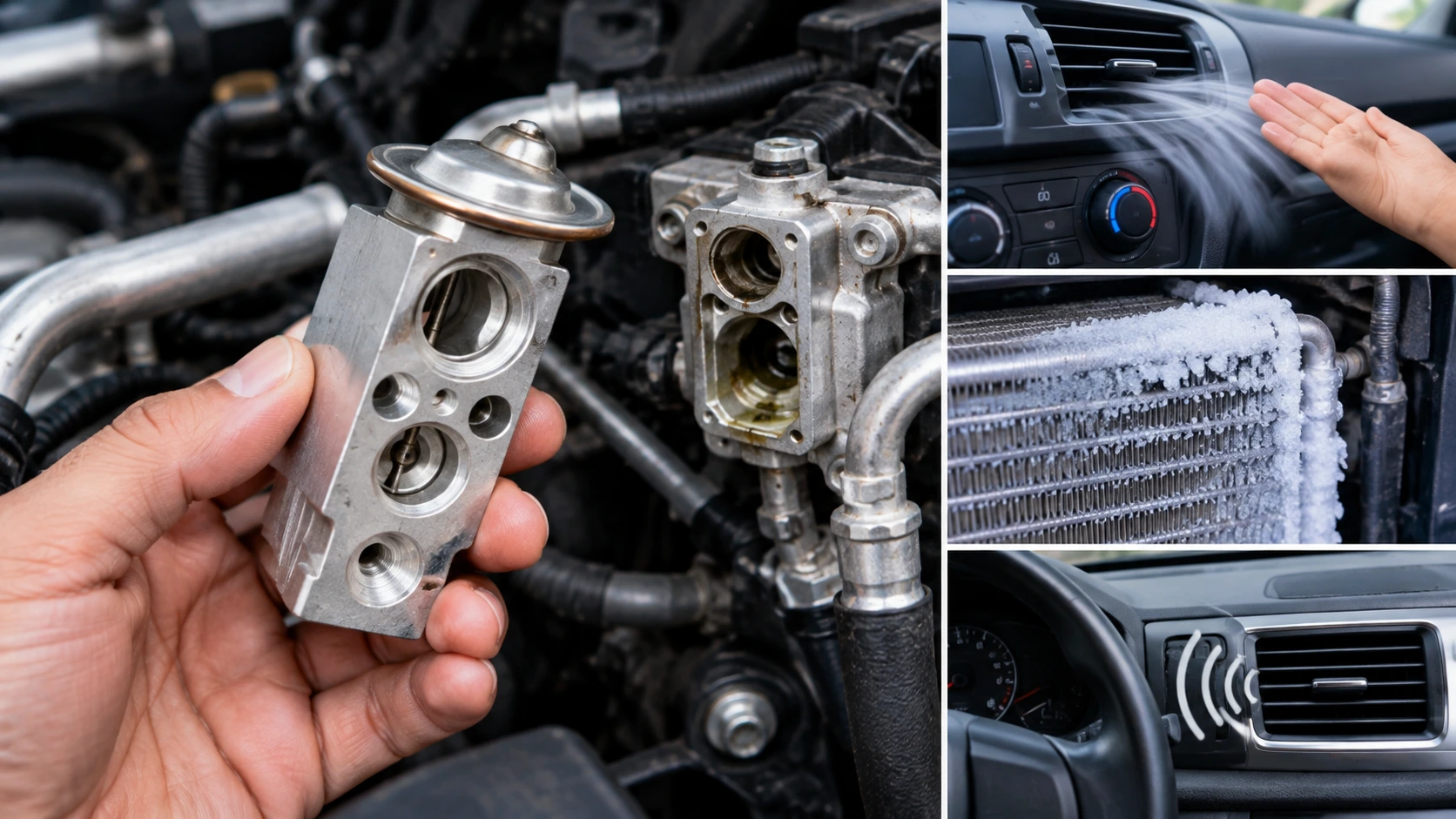
You set the AC to full on the drive home along Al Khail Road. It blows icy for a few minutes, turns lukewarm, then goes cold again. Some days you see frost on the vents. These are typical bad AC expansion valve symptoms, and they are often mistaken for low gas, which leads to repeated top ups that never fix the problem.
The expansion valve is a small part that controls how much refrigerant enters the evaporator behind the dashboard. When it sticks open or closed, the evaporator gets too much or too little refrigerant, and the cooling becomes weak or unstable.
In Dubai, the AC is the system drivers depend on most, and a faulty valve can also overload the compressor. If your AC is not cooling the way it should, an AC repair specialist will usually check the system pressures before adding any gas. This guide explains what the expansion valve does, the signs it has failed, why it fails, how it is tested and what replacement involves.
Bad AC Expansion Valve Symptoms: Quick Answer
The main bad AC expansion valve symptoms are weak or warm air from the vents, cooling that switches between cold and warm, frost on the evaporator, the AC lines or the vents, unusual high or low side pressure readings, a compressor that runs constantly or cycles too often and very hot lines on the high pressure side.
Nissens explains that a clogged or stuck closed valve lets too little refrigerant through and raises system pressure, while a valve stuck open lets too much through. Frost points to excess refrigerant. A mechanic confirms the fault with gauge readings, line temperatures and a full system check before replacing the valve.
Table of Contents
- What the AC Expansion Valve Does
- Valve Stuck Closed or Stuck Open: Two Sets of Symptoms
- Why Expansion Valves Fail in Dubai
- Weak or Warm Air From the Vents
- Cooling That Switches Between Cold and Warm
- Frost on the Vents, Lines or Evaporator
- Unusual High and Low Side Pressures
- Very Hot High Pressure Lines
- Compressor Running Constantly or Cycling Often
- Expansion Valve or Orifice Tube?
- Faults That Look Like a Bad Expansion Valve
- How a Workshop Tests an Expansion Valve
- What Expansion Valve Replacement Involves
- Why Topping Up Gas Does Not Fix a Bad Valve
- Can a Bad Expansion Valve Damage the Compressor?
- How to Protect the AC System
- What Is the Receiver Drier and Why Is It Replaced?
- Does the Type of AC Gas Matter?
- FAQ
- Conclusion
What the AC Expansion Valve Does
A car AC moves heat out of the cabin using refrigerant. The compressor squeezes the refrigerant into a hot, high pressure gas. The condenser at the front of the car cools it into a liquid. The expansion valve then lets that liquid into the evaporator behind the dashboard at a controlled rate.
As the refrigerant passes through the valve, its pressure drops sharply and it becomes very cold. Inside the evaporator, it absorbs heat from the cabin air that the blower pushes across it. The cooled air then comes out of the vents.
The valve adjusts the flow based on the temperature of the refrigerant leaving the evaporator. Too much flow floods the evaporator. Too little starves it. Either way, cooling suffers.
Valve Stuck Closed or Stuck Open: Two Sets of Symptoms
An expansion valve usually fails in one of two ways. Nissens explains that a clogged or stuck closed valve lets too little refrigerant through, which raises system pressure and can overheat the compressor.
A valve stuck open lets too much refrigerant through. Nissens notes that excess refrigerant can reach the compressor, and that frost on the evaporator or vents is a sign the system is getting too much refrigerant.
A valve can also stick part way or move erratically, which causes cooling that comes and goes. Knowing which way the valve has failed helps explain the symptoms and the gauge readings.
Why Expansion Valves Fail in Dubai
Nissens describes the expansion valve as fragile and temperature sensitive, and notes that impurities inside the system can cause it to malfunction. The valve has a very small opening, so even tiny particles can block it.
Debris often comes from a failing compressor, which sheds metal particles into the refrigerant. Moisture in the system can form ice or acid that damages the valve. Moisture enters through leaks or when a system is opened and not properly vacuumed before recharging.
Dubai’s heat makes the AC work harder and longer than in most places. The system runs at high pressure for most of the year, which stresses every part, including the valve.
Weak or Warm Air From the Vents
Nissens lists poor performance and warm air among the main signs of a faulty expansion valve. The vents may blow cool air that never gets truly cold, or warm air on hot afternoons.
A valve stuck closed starves the evaporator, so it cannot absorb enough heat from the cabin air. The air comes out only slightly cooler than outside. On a summer afternoon when the air passes 45°C, the difference is very noticeable.
Weak cooling has many causes, including low gas, a blocked condenser, a failing compressor and a dirty cabin filter. Gauge readings are needed to point to the valve.
Cooling That Switches Between Cold and Warm
Nissens notes that air alternating between cold and warm is a sign the valve should be inspected straight away. A valve that sticks and releases lets refrigerant through in bursts, so the evaporator swings between flooded and starved.
You may notice the vent temperature change every few minutes without touching the controls. The pattern may get worse as the car warms up or during long drives.
Cooling that comes and goes can also come from a compressor clutch that is cutting in and out, or a pressure switch fault. Checking pressures while the symptom happens tells them apart.
Frost on the Vents, Lines or Evaporator
Frost or ice is a clear warning sign. Nissens states that frost on the evaporator or vents indicates the system is getting too much refrigerant, which points to a valve stuck open.
You may see frost on the AC line near the firewall, white mist from the vents or reduced airflow as ice blocks the evaporator fins. Once the evaporator ices over, the air can barely pass through, and cooling drops sharply.
Frost can also come from a faulty evaporator temperature sensor or a blower that runs too slowly. A mechanic checks those before replacing the valve.
Unusual High and Low Side Pressures
Gauge readings are the main way to diagnose the valve. Nissens gives typical readings of about 2 to 3 bar on the low side and 14 to 24 bar on the high side for a healthy system, while noting that abnormal high or low readings can point to a bad valve.
A valve stuck closed often shows a very low low side pressure, sometimes close to a vacuum, with a high side that may be normal or high. A valve stuck open often shows a high low side pressure and a lower high side than expected, because refrigerant is passing through too freely.
Readings change with outside temperature, engine speed and the car model, so a mechanic compares them with the manufacturer’s chart. In Dubai’s heat, high side readings run higher than in cooler climates.
Very Hot High Pressure Lines
Nissens notes that temperatures above 50°C from the compressor outlet through to the receiver drier may point to a blockage or malfunction. A blocked valve stops refrigerant moving freely, so heat and pressure build up on the high side.
You should not touch AC lines with the engine running, because they can be very hot or very cold. A mechanic uses an infrared thermometer or a clamp on probe to measure line temperatures safely.
A large temperature difference across the valve itself, with frost on one side, also helps confirm a valve fault.
Compressor Running Constantly or Cycling Often
A faulty valve upsets the pressures the compressor depends on. With a valve stuck closed, the low side pressure drops quickly, and the compressor may switch on and off every few seconds as the low pressure switch trips.
With a valve stuck open, the compressor may run constantly without ever reaching the target pressure, and liquid refrigerant may reach it. Nissens warns that a clogged valve can overheat the compressor.
Frequent cycling or constant running both wear the compressor clutch and shorten its life. That is why a valve fault should be fixed quickly.
Expansion Valve or Orifice Tube?
Not every car has an expansion valve. Many cars use a fixed orifice tube instead, which is a simple tube with a small hole and a filter screen. It does the same job but cannot adjust the flow.
Most European and Japanese cars sold in the UAE use an expansion valve, often mounted at the firewall where the AC lines enter the dashboard. Some American models use an orifice tube in the liquid line.
An orifice tube blocks in the same way as a stuck closed valve. The symptoms are similar, and the fix is to replace the tube and find the source of the debris.
Faults That Look Like a Bad Expansion Valve
Low refrigerant from a leak is the most common cause of weak cooling, and it can look like a valve stuck closed. A blocked condenser raises high side pressure. A failing compressor cannot build enough pressure. A blocked receiver drier restricts flow.
A dirty cabin filter or failing blower reduces airflow and can make the evaporator ice up. A faulty pressure or temperature sensor can make the system switch off early.
The guides on bad AC condenser symptoms and bad AC evaporator symptoms explain those faults. A full gauge test is the only way to separate them.
How a Workshop Tests an Expansion Valve
Nissens advises a complete system diagnosis using pressure gauges to check operating pressures. The mechanic connects gauges to the high and low service ports, runs the engine at a set speed with the AC on full and compares the readings with the manufacturer’s chart.
The mechanic also measures line temperatures before and after the valve and at the evaporator outlet, and checks the vent temperature with a thermometer. Frost, temperature differences and pressure patterns together point to the valve.
The system is checked for leaks with dye or an electronic detector, because low gas causes similar readings. The compressor, condenser and fans are checked too. Book these tests with an experienced car mechanic near you before any parts are ordered.
What Expansion Valve Replacement Involves
First, the refrigerant is recovered from the system with a recovery machine. It must never be released into the air.
Then the valve is removed. On many cars, it sits at the firewall and can be reached from the engine bay. On others, it is inside the dashboard with the evaporator.
A new valve is fitted with new O rings, lubricated with the correct AC oil. Most workshops also replace the receiver drier or desiccant bag, because it absorbs moisture and traps debris, and an old one may already be saturated.
The system is then vacuumed for a set time to remove moisture and air, checked for leaks and recharged with the correct amount and type of refrigerant.
On some cars, the front bumper or other parts must come off for access, and a careful workshop protects and refits panels so they are not scratched and do not need paint and panel repair.
Why Topping Up Gas Does Not Fix a Bad Valve
Many drivers top up the AC gas when cooling gets weak. If the valve is stuck, adding gas does not fix the cause. SlashGear notes that simply adding more refrigerant will not fix the underlying problem.
Overcharging a system with a valve stuck open can make the symptoms worse and push more liquid toward the compressor. Undercharging a system with a blocked valve hides the real fault.
A proper diagnosis with gauges, followed by recovering and recharging the exact amount of refrigerant, is the only reliable fix.
Can a Bad Expansion Valve Damage the Compressor?
Yes. Nissens warns that a clogged valve can overheat the compressor, and that a valve stuck open can let too much refrigerant reach it. Liquid refrigerant reaching the compressor can damage its internal parts.
A compressor that has already failed can also be the cause of the valve failure, by shedding debris that blocks it. In that case, the system needs flushing, a new compressor, a new valve and a new receiver drier.
If the compressor seizes, it can damage or break the drive belt. On many cars, the same belt drives the water pump and alternator, so the engine can overheat or the battery can go flat. If that happens on a highway, reach the hard shoulder rather than stopping in a live lane, which brings a AED 1,000 fine and six black points under Article 98 of the UAE Federal Traffic Law, then call roadside assistance.
How Long Does an Expansion Valve Usually Last?
There is no fixed life for an expansion valve. Many last for the life of the car. Others fail early because of debris from a failing compressor, moisture from an old leak or a system that was recharged without proper vacuuming.
In UAE conditions, the AC runs at high pressure for most of the year, which adds wear to every part. A valve that has worked for ten years may still fail if the compressor starts shedding debris.
Fixing leaks early and having the system serviced properly, with vacuuming before every recharge, gives the valve the best chance of lasting.
How to Protect the AC System
Have leaks fixed rather than topping up again and again, because every leak lets moisture in. Make sure any recharge includes a proper vacuum, so moisture and air are removed first.
Replace the cabin filter on time, so the evaporator gets good airflow and does not ice up. A cabin filter change is cheap and quick. Keep the condenser fins clean so system pressures stay normal.
A regular car service in Dubai includes an AC performance check. Before summer, choose a car garage near you that tests the AC with gauges rather than only topping up gas. If the AC stops cooling at home, a mobile mechanic can check the fuses, fans and compressor clutch before you book a full test.
What Is the Receiver Drier and Why Is It Replaced?
The receiver drier is a small canister in the high pressure line, or a bag built into the condenser on many newer cars. It holds a material that soaks up moisture and traps debris in the refrigerant.
Moisture is a big threat to the expansion valve. It can freeze at the valve’s tiny opening or mix with refrigerant oil to form acid. Once the drier is saturated, it cannot protect the valve any more.
That is why most workshops replace the drier whenever the system is opened for a valve or compressor repair. It is a small extra cost that protects the new parts.
Does the Type of AC Gas Matter?
Yes. Most older cars use R134a refrigerant, while many newer models use R1234yf. The two are not interchangeable, and each needs the right amount of the correct oil.
The amount of refrigerant matters as much as the type. Too much or too little upsets the pressures, which can look like an expansion valve fault. The correct figure is usually printed on a label under the bonnet.
A workshop with the right recovery and recharge machine weighs the refrigerant in exactly. Regular car maintenance that includes an AC check catches charge problems early.
FAQ
Here are the questions Dubai drivers most often ask about AC expansion valves.
What does a bad expansion valve do?
It lets too much or too little refrigerant into the evaporator. Too little gives weak or warm air and high system pressure. Too much causes frost on the vents or lines. Cooling may also switch between cold and warm.
Can a bad expansion valve cause frost?
Yes. Nissens explains that frost on the evaporator or vents is a sign the system is getting too much refrigerant, which points to a valve stuck open. A faulty temperature sensor or weak airflow can also cause icing.
How do mechanics test an expansion valve?
They connect gauges to the high and low sides, run the AC on full and compare pressures with the manufacturer's chart. They also measure line temperatures and vent temperature, and check for leaks before replacing the valve.
Will adding AC gas fix it?
No. If the valve is stuck, adding gas does not fix the cause and can make symptoms worse. The system needs testing with gauges, a new valve if faulty, a vacuum and a recharge with the exact amount of refrigerant.
Can an expansion valve damage the compressor?
Yes. A clogged valve can overheat the compressor, and a valve stuck open can let liquid refrigerant reach it. Fixing the valve early protects the compressor, which costs far more to replace.
Conclusion
A bad AC expansion valve shows up as weak or warm air, cooling that switches between cold and warm, frost on the vents or lines, unusual pressures, very hot high side lines and a compressor that cycles too often. Debris and moisture are the usual causes, and Dubai’s year round AC use adds strain. A full gauge test confirms the fault, and replacement should include a new receiver drier, a vacuum and an exact recharge.
Rapid Rev Garage is a full workshop open 24 hours at Al Khail Gate, 12th Street, Al Quoz Industrial Area 2, serving passenger cars across Al Quoz, Business Bay, Jumeirah, Al Barsha, Satwa, Downtown and the Sheikh Zayed Road corridor. Visit https://rapidrevgarage.com, send your car model and AC symptoms on WhatsApp, or get directions on Google Maps.
Rapid Rev Garage | Bad AC Expansion Valve Symptoms | Al Quoz, Dubai