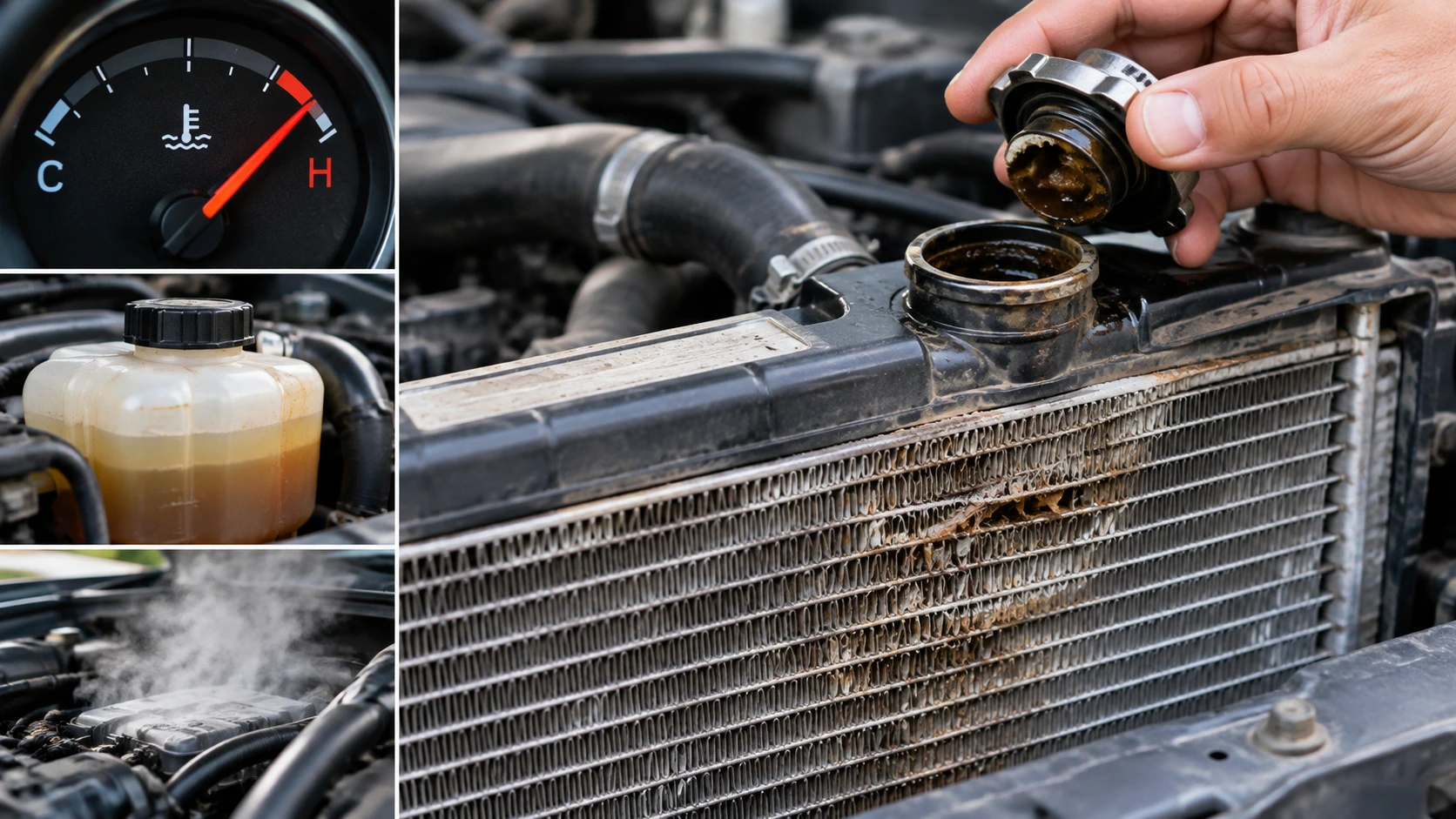
The coolant tank is full, the thermostat was replaced last year, and the fan comes on. Yet the temperature needle still climbs in slow traffic on Sheikh Zayed Road, and the AC blows warmer at the lights. These are common clogged radiator symptoms, and they are easy to miss because nothing appears to be leaking or broken.
A radiator can block in two ways. Inside, scale, rust and old coolant deposits narrow the thin tubes, so less coolant flows through. Outside, dust, sand, insects and leaves pack the fins, so less air passes through. Either way, the radiator cannot shed heat, and the engine runs hotter than it should.
This guide explains how the radiator works, the signs of a blockage, why Dubai conditions clog radiators faster, how a workshop finds the problem and when cleaning, flushing or replacement is the right fix.
Clogged Radiator Symptoms: Quick Answer
The main clogged radiator symptoms are an engine that runs hot or overheats under load and in slow traffic, cold spots across the radiator surface, coolant that looks rusty, brown or sludgy, coolant loss or overflow, a temperature gauge higher than normal on long climbs and weaker AC cooling at idle.
Internal blockages come from scale, rust and mixed or old coolant. External blockages come from dust, sand and insects packed into the fins. A mechanic checks the radiator surface with an infrared thermometer, inspects the fins and coolant, and pressure tests the system. Light blockages can be cleaned or flushed, while heavy internal clogging usually means a new radiator.
Table of Contents
- How the Radiator Cools Your Engine
- Internal and External Radiator Blockages
- Why Radiators Clog Faster in Dubai
- Engine Running Hot or Overheating Under Load
- Overheating Mostly in Slow Traffic
- Cold Spots Across the Radiator
- Rusty, Brown or Sludgy Coolant
- Coolant Loss and Overflow
- Bent or Packed Fins at the Front of the Radiator
- Weaker AC at Idle
- Faults That Look Like a Clogged Radiator
- How a Workshop Diagnoses a Clogged Radiator
- Cleaning, Flushing or Replacing the Radiator
- Can a Coolant Flush Clear a Blocked Radiator?
- Can You Clean the Radiator Fins Yourself?
- Is It Safe to Drive With a Clogged Radiator?
- How to Keep the Radiator Clear
- How Long Does a Radiator Usually Last?
- FAQ
- Conclusion
How the Radiator Cools Your Engine
The radiator sits at the front of the car, behind the grille and usually behind the AC condenser. Hot coolant from the engine flows in through the top hose, passes through rows of thin tubes and leaves through the bottom hose, cooler than it entered.
Thin metal fins between the tubes spread the heat out. Air moving through the fins, from road speed or the cooling fan, carries the heat away. The cooled coolant then returns to the engine to pick up more heat.
The whole system depends on two flows working together: coolant moving through the tubes and air moving through the fins. A blockage in either one reduces how much heat the radiator can remove.
Internal and External Radiator Blockages
An internal blockage forms inside the tubes. Scale from hard tap water, rust from the engine and deposits from old or mixed coolant build up on the tube walls. Some tubes block completely, so coolant only flows through the ones that remain open.
An external blockage forms on the fins. Dust, sand, insects, leaves and road dirt get pulled in by the airflow and pack between the fins. The fins may look fine from the front if the condenser hides them.
A mechanic writing for Mechanical Malarkey describes a case where the radiator was caked with dirt even though the condenser in front of it looked clean. Both kinds of blockage cause overheating, but they need different fixes, so finding which one you have matters.
Why Radiators Clog Faster in Dubai
Fine dust and sand are the biggest external threat. Dust storms, construction sites and industrial roads around Al Quoz load the air with fine particles. The radiator fan pulls that air straight through the fins every time the car idles with the AC on.
Insects add to it, especially on highway drives at night along routes such as Emirates Road. Their remains stick to the condenser and radiator and trap more dust.
Internal clogging often comes from coolant habits. Topping up with tap water adds minerals that form scale when heated. Mixing different coolant types can create sludge. On a summer afternoon when the air passes 45°C, the cooling system runs at high temperature for long periods, which speeds up deposit build up.
Engine Running Hot or Overheating Under Load
Overheating under load is one of the most common signs. Climbing the ramps of a multi storey car park, towing, carrying a full car or driving uphill on the Hatta road all make the engine produce more heat. A partly clogged radiator copes with light driving but cannot keep up when demand rises.
The temperature gauge may sit slightly higher than usual on easy drives and then climb toward the red under load. Some drivers notice the gauge only rises on summer afternoons.
If the gauge reaches the red or you see steam, pull over and switch off. Driving an overheating engine can warp the cylinder head and blow the head gasket. Never open the radiator cap on a hot engine.
Overheating Mostly in Slow Traffic
A radiator with packed fins struggles most when there is no road speed to push air through it. In slow traffic, the cooling fan has to pull air through the blocked fins on its own, and less air gets through.
The engine may run normally on the highway, then heat up in queues on Al Khail Road or at the exit of a busy car park. Once traffic moves, the temperature drops again.
The same pattern can come from a failed cooling fan or fan relay, so a mechanic checks the fan before blaming the radiator. The guide on bad cooling fan relay symptoms explains how to tell them apart.
Cold Spots Across the Radiator
Cold spots are one of the clearest signs of an internal blockage. With the engine fully warm, the radiator should feel evenly hot across its surface, cooling gradually from the inlet side to the outlet side.
If some tubes are blocked, coolant cannot flow through them, so those areas stay much cooler. On an infrared thermometer, the radiator shows cold bands or patches where tubes are clogged.
Do not touch a hot radiator with bare hands. The surface and the coolant can be well above 90°C. A mechanic uses an infrared thermometer to scan the surface safely.
Rusty, Brown or Sludgy Coolant
Healthy coolant is clear and brightly coloured, usually green, pink, orange or blue depending on the type. Coolant that looks brown, rusty, murky or has sludge floating in it carries the deposits that clog radiators.
Check the coolant in the overflow tank with the engine cold. You can also look at the inside of the radiator cap on cars that have one. Crusty deposits on the cap or tank point to scale and corrosion in the system.
Brown coolant with an oily film can also point to a head gasket problem, where oil mixes with coolant. That needs testing before any flush is done.
Coolant Loss and Overflow
A clogged radiator raises coolant temperature and pressure. Coolant can boil and push out through the overflow tank, so the level drops even though there is no leak. You may see coolant around the overflow tank or smell coolant after driving.
Higher pressure also stresses hoses, seams and the radiator end tanks. Plastic end tanks can crack, and hoses can split. A radiator that overheats repeatedly often starts leaking from its seams.
Boiling coolant that sprays onto the bodywork can mark the paint if it is left in the sun. Stains that are not washed off quickly may need paint and panel repair.
Bent or Packed Fins at the Front of the Radiator
Look through the grille with a torch. If you can see dust, sand, insects or leaves packed between the fins, airflow is being blocked. Bent or flattened fins from stones, pressure washing or minor knocks also block airflow.
The condenser sits in front of the radiator on most cars, so the radiator fins may only be visible from the engine side, behind the fan. Mechanical Malarkey describes a radiator that was caked with dirt while the condenser in front looked clean.
A few bent fins do little harm. Large flattened or packed areas reduce cooling noticeably, especially in summer traffic.
Weaker AC at Idle
A clogged radiator also affects the AC. The condenser and radiator share the same airflow, and heat from a hot radiator makes it harder for the condenser to cool the refrigerant.
Mechanical Malarkey describes a case where high side pressure climbed to about 500 psi at 3,000 rpm before the pressure switch cut out the compressor. The cause was a radiator caked with dirt. Once the radiator was cleaned, pressures returned to normal.
If your AC blows warm at idle and the engine runs hot at the same time, ask for both systems to be checked. An AC system check should include a look at the radiator and condenser fins.
Faults That Look Like a Clogged Radiator
Several faults cause the same symptoms. A thermostat stuck closed stops coolant reaching the radiator.
A failing water pump moves too little coolant. A cooling fan or fan relay that does not work stops airflow in traffic. A failing head gasket pushes combustion gas into the coolant.
Low coolant from a leak causes overheating with a clean radiator. Air trapped in the system after a repair causes hot spots and gauge jumps.
The guides on bad car thermostat symptoms and failing water pump symptoms explain those faults. Testing finds the real cause before the radiator is replaced.
How a Workshop Diagnoses a Clogged Radiator
A proper diagnosis starts with the coolant level and condition, checked with the engine cold. The mechanic looks at the colour, checks for rust, sludge or oil, and inspects the radiator fins from both sides.
With the engine warm, the mechanic scans the radiator surface with an infrared thermometer. Even heat with a steady drop from inlet to outlet is normal. Cold patches point to blocked tubes. The upper and lower hose temperatures are compared too.
The mechanic also pressure tests the system for leaks, checks the fan operation and confirms the thermostat opens. Some workshops test the coolant for combustion gas to rule out a head gasket. Book these tests with an experienced car mechanic near you before deciding on cleaning or replacement.
Cleaning, Flushing or Replacing the Radiator
External blockages are usually cleaned. The fan shroud or condenser may be removed for access, and the fins are cleaned with low pressure water or air, blowing from the engine side outward. Mechanical Malarkey describes removing the condenser and fans and spraying water through the back of the radiator to restore normal pressures.
Light internal deposits may respond to a cooling system flush with a suitable cleaner, followed by fresh coolant of the correct type. A flush removes loose sludge and some scale.
Heavy internal clogging usually means a new radiator. Hard scale inside thin tubes rarely flushes out fully, and modern radiators with plastic end tanks are not designed to be opened and rodded. Replacement also suits radiators with cracked tanks or many bent fins.
Can a Coolant Flush Clear a Blocked Radiator?
A flush can help with light deposits and sludge, but it rarely clears tubes that are fully blocked. Hard mineral scale from tap water bonds to the tube walls and resists cleaners.
A flush is most useful as prevention. Draining old coolant and refilling with the correct type at the interval in your owner’s manual stops deposits forming in the first place.
If a flush is done on a heavily clogged radiator, loosened debris can move into the heater core or engine passages. That is why a mechanic checks for cold spots first, to decide whether flushing or replacement makes more sense.
Can You Clean the Radiator Fins Yourself?
You can rinse loose dust and insects from the front with a gentle stream of water, with the engine cold. Spray from behind the radiator outward if you can reach it, so dirt is pushed out the way it came in.
Never use a high pressure washer close to the fins. It flattens them and makes airflow worse. Avoid spraying water directly onto electrical connectors and the alternator.
Packed dust between the condenser and radiator usually needs the condenser or fan removed, which is a workshop job. If the fins look clean from the front but the engine still runs hot, the blockage may be hidden behind the condenser.
Is It Safe to Drive With a Clogged Radiator?
A slightly clogged radiator may let the engine run warm without overheating on easy drives, but it is a risk in Dubai summer traffic. Overheating can happen quickly, and the repair costs rise sharply once the head gasket is damaged.
If the gauge climbs toward the red, switch off the AC to reduce load and pull over when it is safe. If you are on a highway, reach the hard shoulder rather than stopping in a live lane. Stopping in the middle of the road because of a breakdown brings a AED 1,000 fine and six black points under Article 98 of the UAE Federal Traffic Law. Once safe, call roadside assistance.
An overheated engine should go to the workshop on a flatbed tow truck. If the engine has overheated badly, an engine repair specialist should check the head gasket before the car goes back into daily use.
Why Does My Car Overheat After a Dust Storm?
Dust storms load the air with fine particles that the cooling fan pulls straight into the radiator and condenser fins. After a heavy storm, a layer of fine dust can coat the fins and cut airflow, especially on cars that already had some build up.
The car may run normally the day before and start running hot in traffic straight after. Rinsing loose dust off the front of the condenser helps, but dust packed between the condenser and radiator may need workshop cleaning.
If you drive often in dusty areas or after storms, have the fins checked at every service. Catching the build up early is far cheaper than dealing with an overheated engine.
How to Keep the Radiator Clear
Use only the coolant type your manufacturer specifies, mixed to the correct strength, and never top up with plain tap water. Change the coolant at the interval in your owner’s manual so deposits do not build up.
Have the radiator and condenser fins checked and cleaned at services, especially after dusty months and long highway trips. Keep the front grille clear of leaves and plastic bags.
A regular car service in Dubai includes coolant and cooling fan checks. If the engine already runs hot, a mobile mechanic can check the coolant and fan at home, and a car garage near you with an infrared thermometer can scan the radiator for cold spots.
How Long Does a Radiator Usually Last?
There is no fixed life for a radiator. Many last for well over ten years, while others clog or leak much sooner. The biggest factors are coolant care and the conditions the car is driven in.
Radiators that are topped up with tap water, or run on old coolant for years, build up scale and corrosion faster. Cars driven daily through dusty areas or parked outside during dust storms clog externally more often.
Plastic end tanks are another weak point. Heat cycles make the plastic brittle, and cracks often appear near the hose necks. A radiator with a cracked tank needs replacing, even if the core is clear.
FAQ
Here are the questions Dubai drivers most often ask about clogged radiators.
How do I know my radiator is clogged?
Common signs are an engine running hot under load or in traffic, cold patches on the radiator surface, rusty or sludgy coolant, coolant overflowing and weaker AC at idle. A mechanic confirms it with an infrared thermometer.
Can a clogged radiator cause overheating?
Yes. Blocked tubes stop coolant flowing through parts of the radiator, and packed fins stop air passing through. Either way, the radiator removes less heat, so the engine overheats, especially in slow traffic or under load.
Will a radiator flush fix a blockage?
A flush can clear light deposits and sludge, but it rarely clears tubes blocked with hard scale. Heavy internal clogging usually needs a new radiator. A mechanic checks for cold spots first to decide.
Can a clogged radiator affect the AC?
Yes. The radiator and AC condenser share the same airflow. A clogged radiator raises AC pressures, and the compressor may cut out. Mechanical Malarkey describes high side pressure reaching about 500 psi from a dirty radiator.
What causes a radiator to clog?
Inside, scale from tap water, rust and deposits from old or mixed coolant block the tubes. Outside, dust, sand, insects and leaves pack the fins. Dubai dust storms and construction dust make external clogging common.
Conclusion
A clogged radiator shows up as overheating under load and in traffic, cold spots, rusty or sludgy coolant, coolant overflow, packed or bent fins and weaker AC at idle. Dubai dust and tap water top ups make blockages more common. An infrared scan, a fin inspection and a coolant check confirm the problem, and the right fix depends on whether the blockage is inside or outside.
Rapid Rev Garage is a full workshop open 24 hours at Al Khail Gate, 12th Street, Al Quoz Industrial Area 2, serving passenger cars across Al Quoz, Business Bay, Jumeirah, Al Barsha, Satwa, Downtown and the Sheikh Zayed Road corridor. Visit https://rapidrevgarage.com, send your car model and symptoms on WhatsApp, or get directions on Google Maps.
Rapid Rev Garage | Clogged Radiator Symptoms | Al Quoz, Dubai