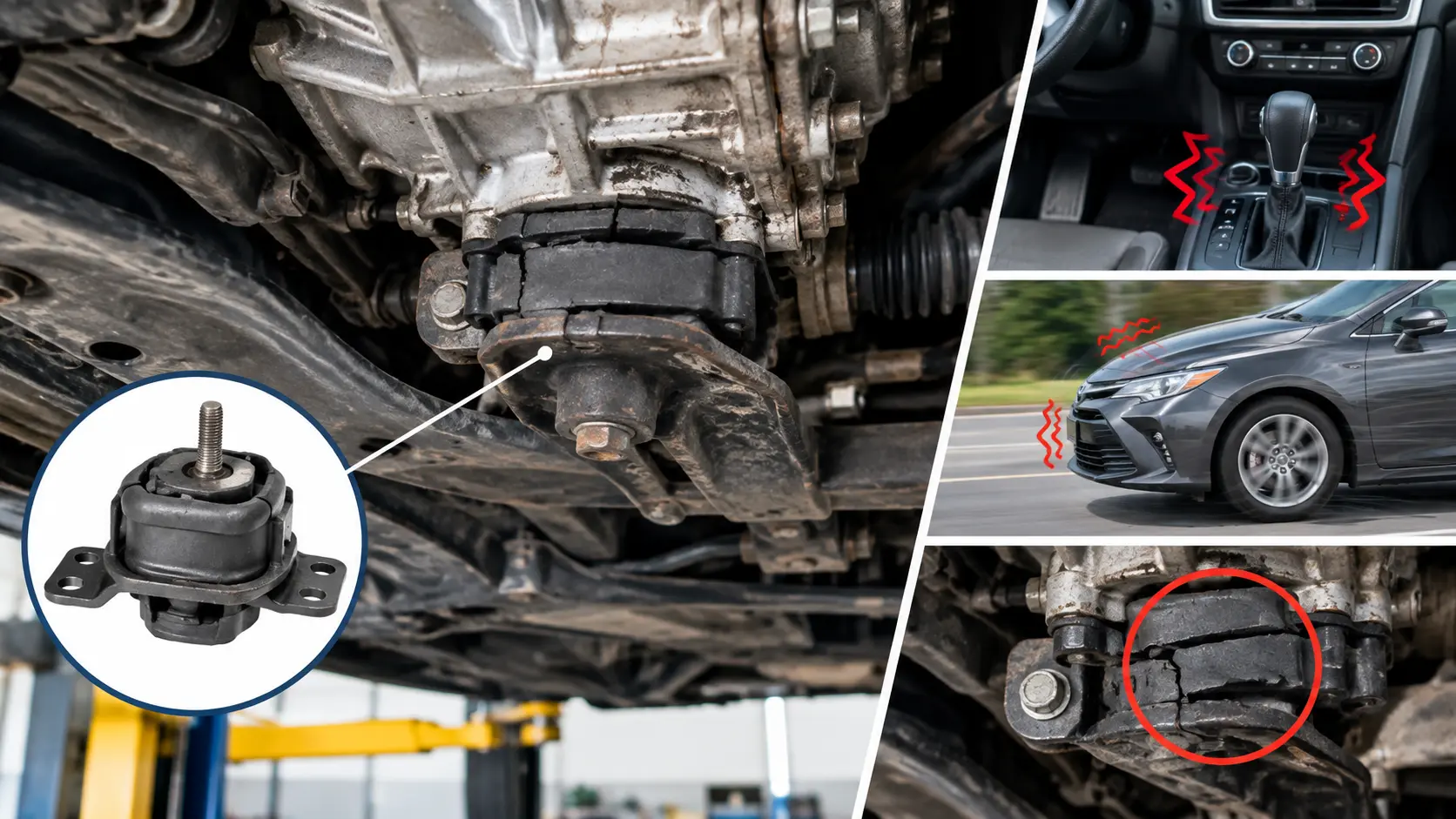
You start the car in a Business Bay car park, press the brake and move the lever from Park to Drive. A heavy thud comes up through the floor. The steering wheel buzzes at the lights on Al Khail Road, and the car jolts every time you pull away. These are classic bad transmission mount symptoms, and they rarely go away on their own.
The transmission mount is a block of rubber, or rubber and fluid, bolted between the gearbox and the car’s body or frame. It holds the gearbox in place and soaks up its movement and vibration. When the rubber cracks, tears or collapses, the gearbox moves more than it should, and you feel that movement as clunks, knocks and shaking.
This guide explains what the mount does, the signs it is wearing out, why heat in Dubai ages rubber mounts faster, how a mechanic tests them and what the repair involves. It also covers the other faults that cause the same clunk, so you can describe the problem clearly to a workshop.
Bad Transmission Mount Symptoms: Quick Answer
The main bad transmission mount symptoms are a clunk or thud when shifting into Drive or Reverse, a jolt when pulling away or lifting off the throttle, extra vibration at idle in the cabin, knocking over speed bumps, visible gearbox movement under load and cracked rubber or leaking fluid at the mount.
Rick’s Free Auto Repair Advice describes a simple load test. A helper holds the brake firmly, selects Drive and gives light throttle while you watch the engine and gearbox with the bonnet open. Healthy mounts allow very little movement. A worn mount lets the assembly lift or twist, and a mechanic then confirms it on a lift.
Table of Contents
- What a Transmission Mount Does
- Rubber, Hydraulic and Active Mounts
- Why Mounts Wear Faster in Dubai
- Clunk When Shifting Into Drive or Reverse
- Jolt When Pulling Away or Lifting Off
- Extra Vibration at Idle
- Knocking Over Speed Bumps and Rough Roads
- Visible Movement Under Load
- Cracked Rubber or Leaking Fluid at the Mount
- Gear Lever or Linkage Problems
- Faults That Feel Like a Bad Transmission Mount
- How a Mechanic Tests Transmission Mounts
- What Mount Replacement Involves
- Should You Replace All the Mounts Together?
- Is It Safe to Drive With a Bad Transmission Mount?
- How Long Do Transmission Mounts Last?
- Does a Bad Mount Affect the Vehicle Inspection?
- Can a Bad Mount Damage the Gearbox?
- What Does a Mount Clunk Sound Like Compared to a Gearbox Fault?
- How to Make Engine and Gearbox Mounts Last Longer
- FAQ
- Conclusion
What a Transmission Mount Does
An engine and gearbox together weigh a lot, and they twist every time the engine delivers power. The mounts hold this heavy assembly in place while letting it move a small amount. That small movement stops engine vibration from passing straight into the body.
Most front wheel drive cars sold in the UAE, such as the Toyota Camry, Nissan Altima and Hyundai Elantra, have the engine sitting sideways. On these cars there are usually three or four mounts. Rick’s Free Auto Repair Advice notes that sideways mounted engines can have three or four motor mounts. One of them supports the gearbox end of the assembly, and on many models it sits under the battery tray.
Rear wheel drive cars, such as the Toyota Land Cruiser, Nissan Patrol and many German saloons, use a different layout. The engine sits lengthways, and the transmission mount sits under the back of the gearbox on a crossmember.
In both layouts the mount has the same two jobs. It carries weight, and it stops the gearbox from twisting too far when torque passes through it.
Rubber, Hydraulic and Active Mounts
The simplest mount is a block of solid rubber bonded to two metal plates. It is cheap and strong, but it passes more vibration into the cabin.
Hydraulic mounts have a rubber body with a chamber of fluid inside. The fluid damps vibration at idle better than rubber alone, which makes the cabin quieter. When a hydraulic mount fails, the fluid leaks out and the mount stops damping.
Some luxury cars use active mounts. These change their stiffness using a vacuum line or an electrical signal from the engine computer. They stay soft at idle for comfort and stiffen when you drive hard. An active mount can fail mechanically, like any mount, or fail through a split vacuum hose or a wiring fault.
Many front wheel drive cars also use a torque strut, sometimes called a dog bone mount. It is a bar with rubber bushes at each end that stops the engine from rocking forward and back. A worn torque strut produces many of the same clunks as a worn transmission mount.
Why Mounts Wear Faster in Dubai
Rubber ages faster in heat. Engine bays in Dubai stay hot for months, and on a summer afternoon when the air passes 45°C, the rubber in the mounts spends long periods near its upper limit. Over time it hardens, shrinks and cracks.
Oil and fluid leaks speed up the damage. Engine oil, gearbox fluid and power steering fluid soften and swell rubber. A small leak from a valve cover gasket or a gearbox seal that drips onto a mount can ruin it years early.
Driving patterns add strain. Stop and start traffic on Sheikh Zayed Road means hundreds of pull aways and stops on a single commute. Each one twists the gearbox against its mounts. Speed bumps in residential communities and rough surfaces around industrial areas such as Al Quoz add more impacts.
Heavy loads count as well. Towing a boat or caravan, or carrying a full load of luggage and passengers on a trip to Hatta, puts extra torque through the drivetrain and extra stress on every mount.
Clunk When Shifting Into Drive or Reverse
This is the symptom most drivers notice first. When you move the lever from Park or Neutral into Drive, the gearbox takes up drive and twists slightly. A healthy mount absorbs that twist quietly. A worn mount lets the gearbox move until metal or hard rubber meets its stop, and you hear and feel a thud.
Rick’s Free Auto Repair Advice lists a heavy thud when shifting into Drive or Reverse among the main signs of failed mounts. The clunk is often louder going into Reverse, because the gearbox twists the opposite way and loads the other side of the mount.
The noise usually comes from under the front of the car, and you may feel it through the floor or the gear lever. It often gets worse over weeks as the rubber breaks down further.
Jolt When Pulling Away or Lifting Off
A worn mount allows the gearbox to rock when the load changes. You feel this as a jolt when you pull away from a stop and another jolt when you lift off the accelerator.
In traffic around Downtown Dubai, where you creep forward and stop again and again, this can feel like the car is lurching. Passengers may notice it before the driver does.
The jolt is usually sharper on hard acceleration. Rick’s Free Auto Repair Advice notes that rattles, thumps and drivetrain jolts are most obvious during hard acceleration, hill climbs and downshifts.
Extra Vibration at Idle
When a mount loses its damping, engine vibration passes straight into the body. You feel a buzz through the steering wheel, the seats and the floor while the car sits in Drive at the lights.
The vibration is often strongest in Drive with your foot on the brake, because the gearbox is loaded and pulling against its mounts. It may ease in Neutral or Park.
Rick’s Free Auto Repair Advice describes mount vibration as one that eases as engine speed rises. That pattern helps a mechanic separate a mount fault from an engine misfire, which usually feels rough at all speeds.
A failed hydraulic mount often causes this symptom without much clunking, because the rubber is still intact but the fluid that damped the vibration has leaked out.
Knocking Over Speed Bumps and Rough Roads
A worn mount lets the gearbox bounce on its supports when the car hits a bump. You hear a knock or thud from the front of the car at low speed, especially over speed bumps in residential areas and car parks.
This symptom is easy to confuse with worn suspension parts. The difference is that a mount knock often changes when you accelerate or brake over the bump, while a suspension knock stays the same.
Visible Movement Under Load
With the bonnet open, a worn mount often shows itself. When a helper holds the brake and selects Drive, then Reverse, the engine and gearbox lift or twist more than normal. Rick’s Free Auto Repair Advice states that a failed mount can let the engine move several inches.
A healthy assembly moves very little during this test. Visible lifting, a gap opening up at the mount or the engine dropping to one side all point to a worn or broken mount.
This test should only be done with care. Keep hands, tools and loose clothing away from the fan, belts and pulleys, and keep the throttle light.
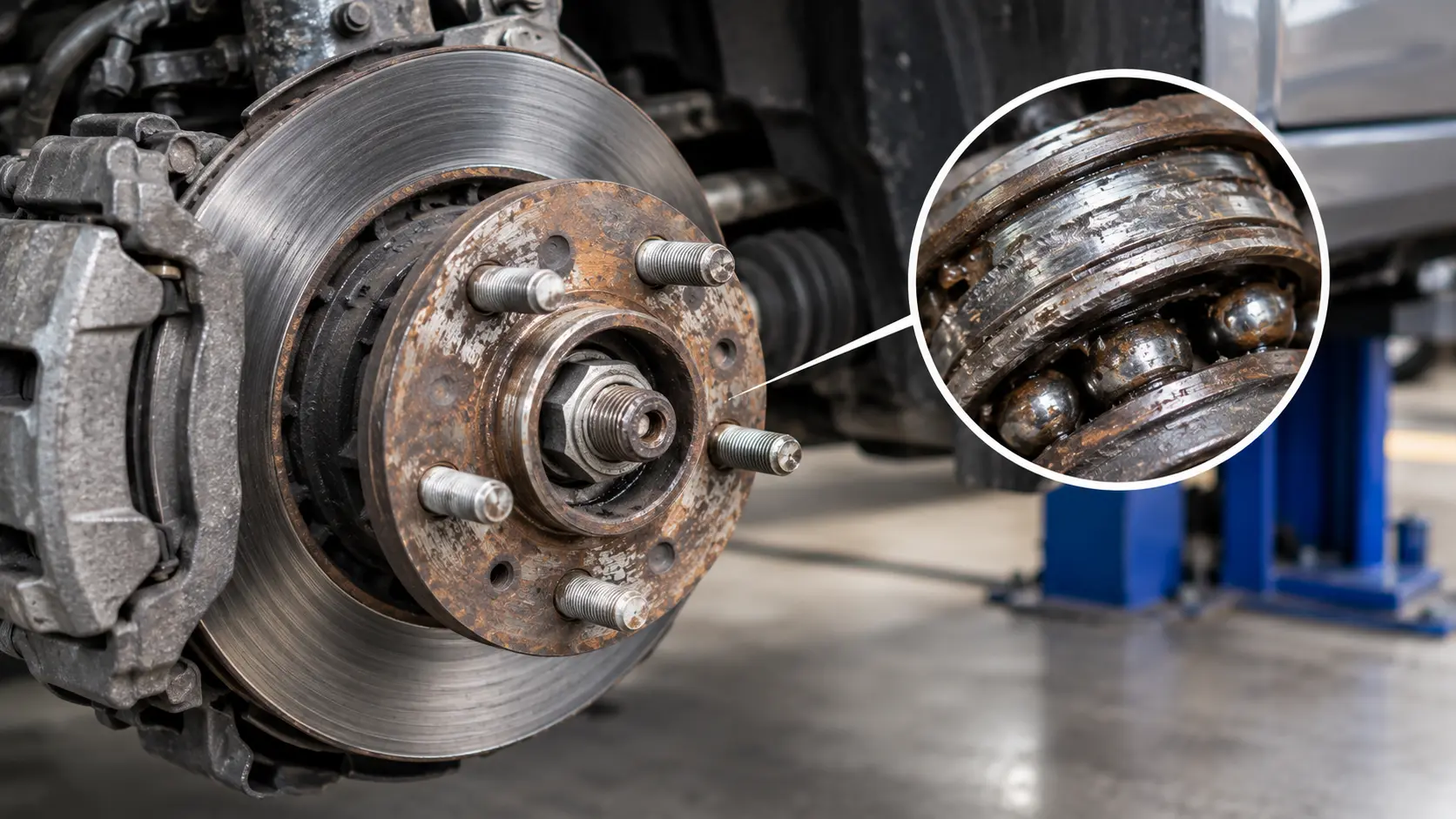
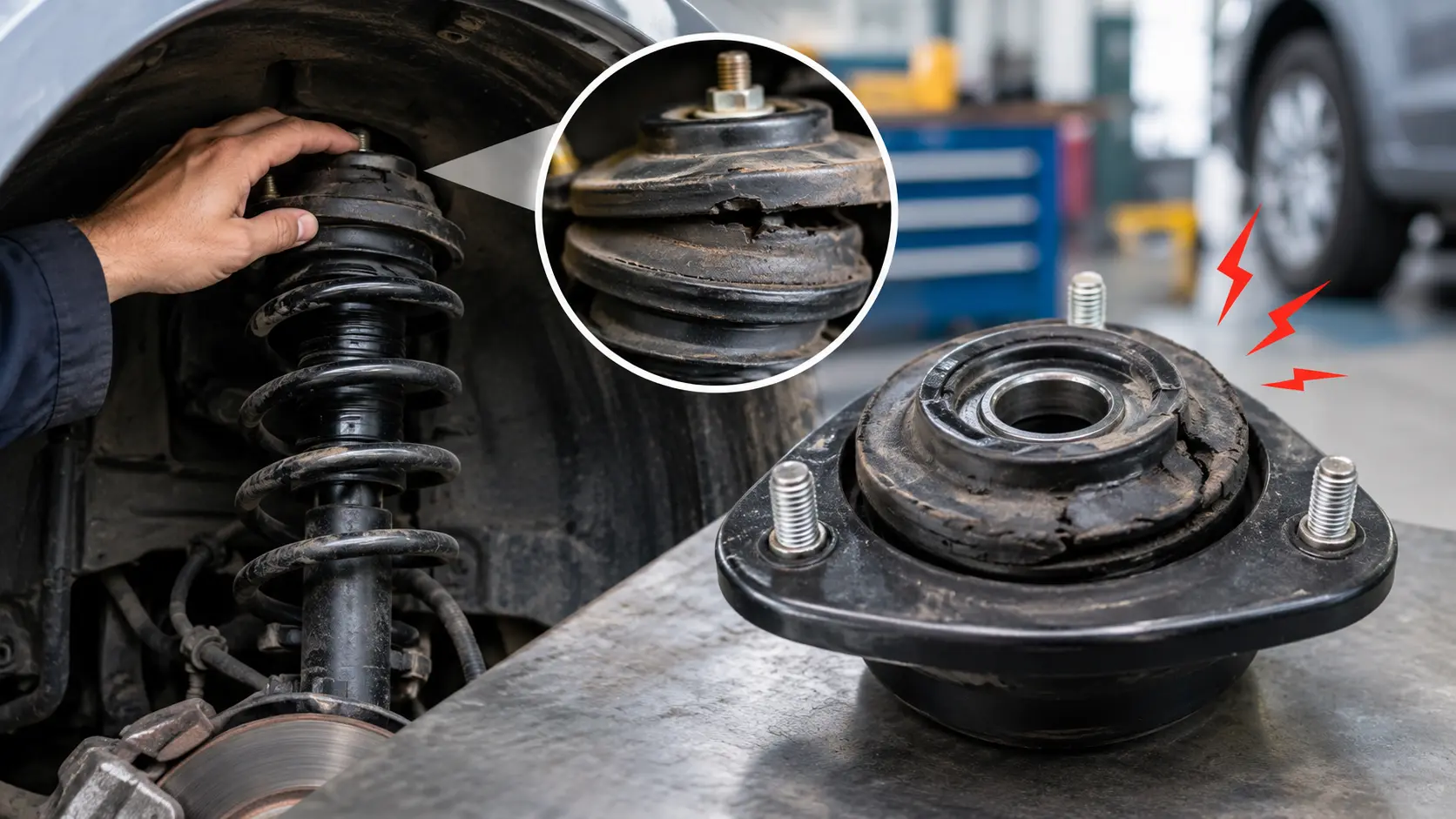
Cracked Rubber or Leaking Fluid at the Mount
A visual check often confirms what you feel. Signs of a worn mount include:
- Cracks across the rubber
- Rubber that has separated from its metal plate
- A sagging or flattened mount
- Dark, oily fluid around a hydraulic mount
- Shiny wear marks where metal has been rubbing on metal
Rick’s Free Auto Repair Advice notes that leaking hydraulic mounts show dark, oily fluid from the mount housing. A mechanic will check whether that fluid comes from the mount itself or from a separate engine or gearbox leak dripping onto it.
Gear Lever or Linkage Problems
When a mount allows too much movement, the gearbox shifts position relative to the gear lever. On cars with a cable or rod linkage, this can make the lever feel vague or stiff.
In some cases, the lever may move further than expected or fail to drop cleanly into a position. Drivers sometimes describe this as the lever slipping. A worn transmission mount is one cause, but a stretched cable or worn linkage bush can cause the same feel.
Faults That Feel Like a Bad Transmission Mount
Several other faults cause clunks and vibration. A careful mechanic checks them before blaming the mount:
- Worn engine mounts. These fail in the same way and often at the same time.
- Worn CV joints or driveshafts. These click on turns and clunk under load.
- Worn suspension bushes or ball joints. These knock over bumps.
- Loose exhaust brackets. A loose exhaust bangs against the body when the engine rocks.
- Harsh engagement inside the gearbox. A faulty valve body or solenoid can make Drive engage with a bang.
- High idle speed. If the engine idles too fast, Drive engages harder than normal.
- Unbalanced wheels or worn tyres. These cause vibration at speed rather than at idle.
If the clunk comes with harsh shifts while the car is moving, the problem may be inside the gearbox rather than the mount. A gearbox that engages Drive with a bang and also shifts hard between gears needs a scan for codes as well as a mount check.
Vibration that only appears above 80 km/h and grows with speed usually comes from the wheels. A wheel balance check at a tyre service is a quick way to rule this out.
How a Mechanic Tests Transmission Mounts
A good car mechanic near you follows a clear order of checks.
First, the mechanic listens to your description and goes for a short test drive. The clunk when selecting Drive and Reverse, the jolt when pulling away and any knock over bumps all give clues.
Next comes the load test. With the bonnet open and the car on level ground, a helper holds the brake hard and shifts between Drive and Reverse with light throttle. The mechanic watches how far the engine and gearbox move and listens for where the knock comes from.
Then the car goes up on a lift. The mechanic inspects each mount for cracks, separation and leaks. A pry bar is used gently to check for excess movement between the mount and its bracket.
The mechanic also checks the engine mounts, the torque strut, the driveshafts and the exhaust brackets. Mounts often wear together, and finding the worst one first saves a second visit.
On cars with active mounts, the mechanic scans for fault codes and checks the vacuum lines and wiring. A split hose or a broken connector can make an active mount behave like a worn one.
What Mount Replacement Involves
Replacing a transmission mount is a common workshop job. The mechanic supports the engine and gearbox from above or below, removes the bolts that hold the old mount, fits the new mount and torques the bolts to the maker’s specification.
On many front wheel drive cars, the battery and its tray come out first to reach the mount. On rear wheel drive cars, the crossmember may need lowering.
Labour time depends on the car. On a simple layout it is a short job. On cars where the mount sits behind other parts, it takes longer. Rick’s Free Auto Repair Advice notes that replacement costs vary widely, and parts prices differ between original and aftermarket mounts.
Original equipment mounts usually match the factory feel best. Some cheaper aftermarket mounts use harder rubber, which can pass more vibration into the cabin. A mechanic can explain the difference for your model.
If the mount fault caused other damage, such as a cracked exhaust joint or a stretched gear cable, those parts are fixed at the same visit. In rare cases, a long ignored broken mount lets the engine move far enough to strain hoses or wiring, and the repair widens to engine repair work.
While the car is on the lift, it is a good time to look at other wear items. Some owners also ask about stone chips on the bonnet and front bumper from highway driving, which can go to paint and panel repair once the mechanical work is done.
Should You Replace All the Mounts Together?
Not always, but it often makes sense. Mounts on the same car share the same heat, the same age and the same driving. When one fails, the others are usually close behind.
There is also a load sharing effect. When one mount is worn, the others carry extra stress and wear faster. Replacing only the worst mount may leave you back at the workshop within months.
A sensible approach is to replace the failed mount and inspect the rest closely. Any that show cracks, sagging or leaks are worth replacing at the same time, because much of the labour overlaps. Mounts that still look and test healthy can stay.
Is It Safe to Drive With a Bad Transmission Mount?
For a short time, a worn mount is usually not an emergency. The car still drives, and many people live with a small clunk for weeks.
The risk grows as the mount breaks down. A fully broken mount lets the gearbox move far enough to strain driveshafts, the gear linkage, hoses and wiring. In extreme cases, the assembly can shift enough to affect gear selection.
If the clunk turns into a loud bang, the gear lever stops working properly or the car loses drive, stop driving. On a highway, turn on your hazard lights and move to the hard shoulder. Stopping in a live lane because of a breakdown brings a AED 1,000 fine and six black points under Article 98 of the UAE Federal Traffic Law. Once safe, call roadside assistance.
If the car is parked at home and you want a first opinion before driving it anywhere, a mobile mechanic can do a visual check and load test in your car park.
How Long Do Transmission Mounts Last?
There is no fixed life. Many mounts last well over 100,000 km, while others wear out much sooner. Heat, oil leaks, towing and hard driving all shorten their life.
In Dubai, the long hot season is the main factor. Rubber that spends years in a hot engine bay hardens and cracks sooner than it would in a cooler climate.
Cars that sit unused for long periods can suffer too. Rubber that does not move can still crack from age and heat.
The best guide is a regular inspection. Mounts are easy to check when the car is on a lift for a service, and catching cracks early lets you plan the repair before it becomes urgent.
Does a Bad Mount Affect the Vehicle Inspection?
A badly worn mount can be noted during a vehicle inspection, especially if it lets the engine or gearbox move visibly or causes an exhaust leak. Buyers of used cars in Dubai often book a vehicle inspection before paying, and a clunk into Drive is one of the first things an inspector notices on the test drive.
A broken mount can also crack an exhaust joint by letting the engine rock too far. An exhaust leak makes noise and can let fumes reach the cabin, which is a clear safety concern.
Fixing a worn mount before an inspection or before selling the car avoids a failed check and gives the buyer one less reason to cut the price.
Can a Bad Mount Damage the Gearbox?
A worn mount does not usually damage parts inside the gearbox directly. The damage tends to happen around it.
When the gearbox moves too much, the driveshafts work at sharper angles. That can wear CV joints and tear their rubber boots, which lets grease out and dirt in. Gear cables and linkages can stretch. Cooler lines and wiring can rub against the body.
On rear wheel drive cars, a sagging transmission mount changes the angle of the propeller shaft. This can cause vibration and wear the universal joints.
Fixing the mount early protects all of these parts. Leaving it often turns a single mount job into a bigger bill.
What Does a Mount Clunk Sound Like Compared to a Gearbox Fault?
A mount clunk is usually a single dull thud as the drive takes up. It happens once, when you select Drive or Reverse or when you change from accelerating to coasting. It comes with a feeling of the car rocking slightly.
A harsh engagement from inside the gearbox feels different. It is a sharp bang or jerk as the clutch inside the gearbox grabs. It often comes with a delay first, where nothing happens for a second and then the gear engages hard.
A gearbox fault also tends to show up during shifts while driving, not just when you select a gear. If every upshift lands with a bang, the problem is more likely the solenoids, valve body or fluid than a mount.
Describing these details to the workshop helps a technician reach the right answer faster.
How to Make Engine and Gearbox Mounts Last Longer
Fix oil and fluid leaks quickly. Leaking oil softens rubber mounts and shortens their life. A leak from a valve cover gasket or gearbox seal is usually a cheap fix compared to replacing a ruined mount.
Shift gently. Come to a full stop before moving from Drive to Reverse, and avoid revving the engine while selecting a gear. These habits reduce the twist on the mounts.
Take speed bumps slowly. Hitting them fast sends a jolt through every mount and suspension part.
Stay within your car’s towing limit, and remember that a fully loaded car on a trip to the mountains puts more stress on the drivetrain than daily commuting.
Book a regular car service in Dubai that includes a look at the mounts while the car is on the lift. If you notice a new clunk or vibration, take it to a car garage near you that tests mounts before replacing gearbox parts.
FAQ
Here are the questions Dubai drivers most often ask about transmission mounts.
What does a bad transmission mount sound like?
It usually sounds like a dull clunk or thud when you shift into Drive or Reverse, and a knock when you pull away, lift off the throttle or drive over speed bumps. The noise comes from under the front of the car.
Can a bad mount cause vibration at idle?
Yes. A worn or leaking mount stops damping engine vibration, so you feel a buzz through the steering wheel, seats and floor while the car sits in Drive at the lights. It often eases in Neutral or Park.
How do mechanics check a transmission mount?
They do a load test with the bonnet open, holding the brake and shifting between Drive and Reverse while watching for movement. Then they inspect the mount on a lift for cracks, separation, sagging and fluid leaks.
Will a bad mount damage other parts?
It can. Too much gearbox movement wears CV joints and boots, stretches gear cables and can crack exhaust joints. On rear wheel drive cars, a sagging mount changes the propeller shaft angle and causes vibration.
Does a broken mount make the car unsafe?
A slightly worn mount is usually not an emergency, but a fully broken one can let the gearbox move far enough to affect gear selection and damage nearby parts. Have it checked as soon as the clunk gets louder.
Conclusion
A bad transmission mount shows up as a clunk when you shift into Drive or Reverse, a jolt when you pull away or lift off, extra vibration at idle, knocking over speed bumps and visible movement under load. Heat, oil leaks and stop and start traffic wear mounts faster in Dubai. A load test and a close inspection on a lift confirm the fault, and early repair protects the driveshafts, linkage and exhaust around it.
Rapid Rev Garage is a full workshop open 24 hours at Al Khail Gate, 12th Street, Al Quoz Industrial Area 2, serving passenger cars across Al Quoz, Business Bay, Jumeirah, Al Barsha, Satwa, Downtown and the Sheikh Zayed Road corridor. Visit https://rapidrevgarage.com, send your car model and a short video of the clunk on WhatsApp, or get directions on Google Maps.
Rapid Rev Garage | Bad Transmission Mount Symptoms | Al Quoz, Dubai